Lowest Currency in the World: Shocking Top 10 Weakest Currencies Of 2025
Imagine this scenario: You have USD 100 in cash, but when you switch it to Lebanese Pounds, you now have more than one and a half million notes. This is the everyday reality of millions of people who deal with the world’s weakest currencies in the modern world. As a finance expert, some figures feel shocking, and I’m sure the numbers we’re about to discuss will mystify us all.
During my travels, when I first came across hyperinflation currencies, I was taken aback. To purchase even the most essentials, people used to require wheelbarrows full of cash. This serves as a stark reminder that every exchange rate comes with a story filled with real people and narratives of steadfast determination and tenacity.
The study of the lowest currency rankings reveals how entire economies can collapse, and while this might seem abstract for the average person, it really makes one think about how people manage during times when currency notes drastically decline in value. This analysis is ideal whether you’re planning a trip abroad, thinking about an investment, or simply want to understand global economic dynamics. I’m sure this deep dive into the world’s most depreciated currencies will alter your perspective forever.
What Causes a Currency to Be Considered the Weakest in the World?
Understanding How Currency Strength vs. Weakness Works
Let me clarify something that many individuals struggle with: why currencies lose value is often disconnected from the numbers you see on screen. Vietnam’s dong may trade at 24,000 to 1 USD, while Vietnam’s economy remains stable. Meanwhile, Lebanon’s pound trades at over 1.5 million to 1 USD because of genuine economic devastation.
What’s most critical is purchasing power—what you can buy with your money locally. Here’s what matters most:
- Exchange rate stability over time
- Inflation rates within the country
- Economic fundamentals like GDP growth
- Political stability and governance quality
- International trade balance
To explain this simply, I always use the Big Mac Index. A Big Mac costs around $5.50 in the US, and if it’s priced at 50,000 units of local currency in another nation, that helps us understand real value versus exchange rates.
Primary Factors Behind Currency Weakness
Through my research, I’ve identified key currency devaluation causes that consistently destroy monetary value:
Political Instability and Poor Governance. When politics becomes unpredictable, investors flee. I’ve witnessed policy changes that used to take years now implemented overnight, causing economic chaos.
Hyperinflation Spirals. This is indeed the most devastating factor. When governments print money to solve budget problems, it creates a vicious cycle—more money chasing the same goods equals higher prices. Venezuela serves as a vivid example of this nightmare scenario.
Economic Sanctions International sanctions can completely isolate a currency from global markets. Iran’s rial demonstrates how political conflicts translate directly into monetary weakness.
Over-Dependence on Single Industries. Countries reliant on oil, agriculture, or minerals face enormous vulnerability. When commodity prices crash, their entire economy—and currency—crash with them.
Top 10 Weakest Currencies in The World: Complete Rankings
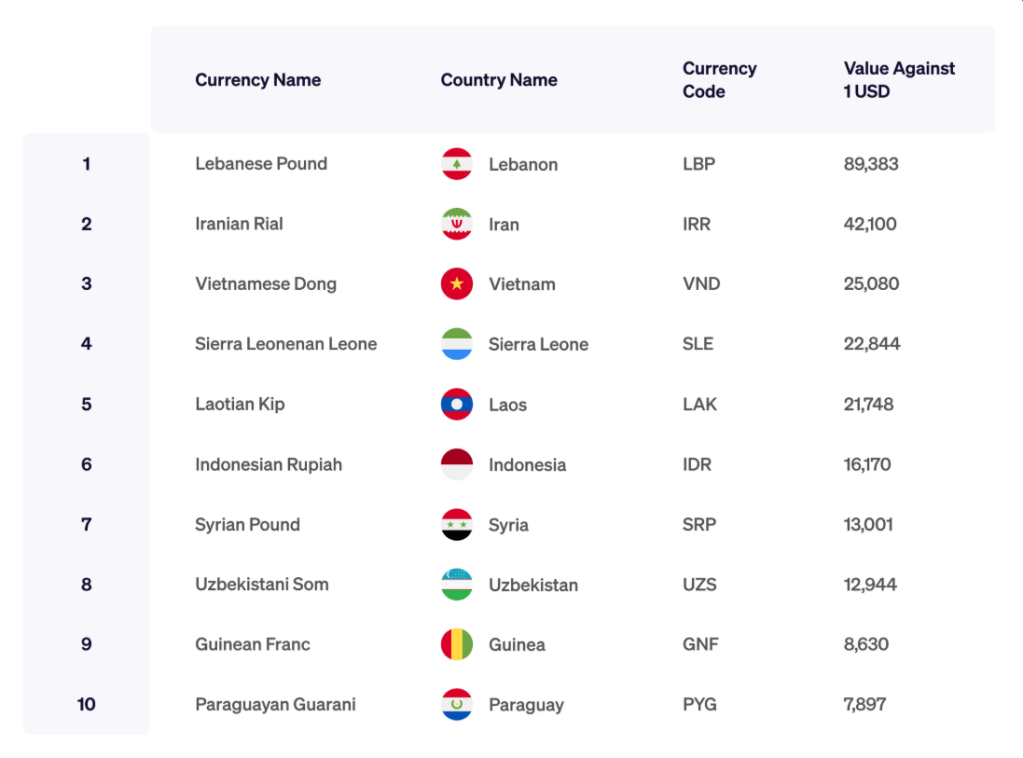
Based on current 2025 data, here’s the definitive ranking of the top 10 weakest currencies worldwide:
| Rank | Currency | Country | Exchange Rate (vs USD) | Primary Weakness | Inflation Impact |
|---|---|---|---|---|---|
| 1 | Lebanese Pound (LBP) | Lebanon | 1,507,500 LBP | Banking crisis + political collapse | Extreme |
| 2 | Iranian Rial (IRR) | Iran | 42,000 IRR | International sanctions | Severe |
| 3 | Vietnamese Dong (VND) | Vietnam | 24,000 VND | Historical legacy (stable economy) | Moderate |
| 4 | Indonesian Rupiah (IDR) | Indonesia | 15,400 IDR | Large denomination system | Low |
| 5 | Uzbekistani Som (UZS) | Uzbekistan | 12,800 UZS | Economic transition | Moderate |
| 6 | Guinean Franc (GNF) | Guinea | 8,600 GNF | Political instability + resource curse | High |
| 7 | Laotian Kip (LAK) | Laos | 21,700 LAK | Underdeveloped economy | Moderate |
| 8 | Sierra Leonean Leone (SLL) | Sierra Leone | 20,500 SLL | Post-conflict recovery | High |
| 9 | Cambodian Riel (KHR) | Cambodia | 4,086 KHR | USD competition domestically | Low |
| 10 | Paraguayan Guaraní (PYG) | Paraguay | 7,400 PYG | Economic challenges | Moderate |
The Lebanese Pound: The World’s Weakest Currency
Lebanon’s economic collapse represents the gravest banking crisis in modern global history, worsened by rampant inflation. This contributes to the LBP’s sustained hyperinflation, making it internationally recognized as the lowest currency in the world.
The Lebanese pound’s weakness stems primarily from political instability, extreme inflation, and a severely depressed economy. Let me explain Lebanon’s tragic story because it perfectly illustrates how quickly a nation’s currency can become worthless.
The Perfect Storm That Destroyed Lebanon’s Currency
Just five years ago, the Lebanese pound traded at 1,500 to the dollar. Today, it trades at over 1.5 million to one dollar, representing a staggering 99.9% devaluation! Lebanon’s collapse wasn’t instantaneous; it’s been a slow-motion disaster unfolding over the years:
The Banking Ponzi Scheme Lebanese banks offered impossibly high interest rates (15-20%) to attract deposits. They used new deposits to pay existing depositors—classic Ponzi scheme mechanics. The entire system imploded once confidence cracked in 2019.
Government Debt Crisis Lebanon’s debt-to-GDP ratio hit 170%, among the world’s highest. The government couldn’t service its debt without printing money, which dramatically accelerated inflation.
Political Paralysis With no functioning government, Lebanon couldn’t implement reforms. International aid remained frozen, and the economic freefall continued unchecked.
Real-Life Impact on Lebanese Citizens
Lebanese friends have described surreal daily experiences to me. A loaf of bread that cost 1,000 pounds in 2019 now costs over 100,000 pounds. People’s life savings, stored in Lebanese pounds, became worthless paper overnight.
Most Lebanese now operate entirely in US dollars when possible. Gas stations, restaurants, and even small shops quote prices in dollars. The Lebanese pound exists mainly for government salaries and small transactions—a shadow of its former role.
Iranian Rial: Sanctions and Economic Warfare
The Iranian rial (IRR) holds a prominent position among the world’s weakest currencies. Years of sanctions, economic struggles, and misguided financial policies have caused its value to plummet dramatically.
Iran’s currency tells a story of geopolitical conflict translating into economic pain for ordinary citizens. The rial has lost over 80% of its value since 2010, making it one of the most catastrophic currency collapses in contemporary history.
How International Sanctions Crushed the Rial
The impact of weak currencies becomes crystal clear when examining Iran’s situation:
Banking System Isolation: International sanctions cut Iranian banks off from the global financial system. This made conducting international trade or accessing foreign currency legally nearly impossible.
Oil Export Restrictions Oil exports dropped from 2.5 million barrels per day to under 500,000 during peak sanctions. Since oil sales provided Iran’s primary foreign currency income, this devastated the rial’s value.
Black Market Domination. With official channels blocked, a thriving black market emerged. The “real” exchange rate often differs dramatically from the official government rate, creating economic chaos.
Survival Strategies in a Collapsing Currency Environment
Iranians have become incredibly innovative at protecting their wealth:
- Gold hoarding as a store of value
- Cryptocurrency adoption despite government restrictions
- Barter systems for major purchases
- Real estate investment as an inflation hedge
- Foreign currency savings when accessible
Vietnamese Dong: Large Numbers, Strong Economy
Here’s where things get interesting. While Vietnam’s dong may appear as one of the weakest currencies in 2025, it’s remarkably stable. This perfectly illustrates why currency strength can’t be judged solely by exchange rates.
Why 24,000 Dong Doesn’t Signal Economic Weakness
Vietnam’s large denomination system stems from historical hyperinflation in the 1980s, but today’s economy tells a completely different story:
Robust Economic Growth Vietnam consistently achieves 6-7% GDP growth annually, making it one of Asia’s star performers. Manufacturing exports drive this success, with companies like Samsung and Intel operating major facilities there.
Currency Stability. While the numbers look intimidating, the dong has remained relatively stable against the dollar for years. The Vietnamese government actively manages exchange rates to support exporters while controlling inflation.
Growing Middle Class Rising incomes and consumption patterns show the dong’s real purchasing power is actually increasing over time—the opposite of truly weak currencies.
Living with Million-Dong Bills
Vietnamese people have adapted brilliantly to their large denomination system. Digital payments are ubiquitous, from street food vendors to luxury shopping. Cash transactions often involve bundled notes, but nobody thinks twice about it.
While tourists initially feel overwhelmed counting zeros, locals navigate effortlessly. A typical lunch might cost 50,000 dong (about USD 2), while a motorbike costs 30 million dong (about USD 1,200). The numbers are large, but the system works seamlessly.
The Hidden Costs of Currency Weakness
Impact of Weak Currencies on Daily Life
Living with a rapidly depreciating currency affects every aspect of life:
Import Price Inflation When your currency weakens, imported goods become exponentially more expensive. Fuel, medicine, electronics, and food ingredients all spike in price.
Savings Destruction: People’s life savings evaporate. A retirement fund that could support someone for years suddenly can’t cover a month’s expenses.
Social Inequality The wealthy, who can access foreign currency and assets, are protected. The poor, stuck with local currency, bear the full impact of devaluation.
Brain Drain Educated professionals emigrate to countries with stable currencies, further weakening the domestic economy.
Investment Opportunities and Risks
Cheapest currencies to buy might seem like bargains, but they’re usually cheap for good reasons. However, some opportunities exist:
Real Estate Arbitrage Property in weak currency countries can offer genuine value, especially in locations with tourism potential or natural resources.
Export Business Advantages: Weak currencies make domestic production incredibly competitive internationally. Labor costs and materials become bargain-priced for foreign buyers.
Manufacturing Relocation: Many companies relocate production to weak currencies to dramatically reduce costs.
High-Risk Speculation Some currencies do recover, offering massive returns to patient investors. Unfortunately, most continue declining, wiping out speculative investments.
Travel Tips for Weak-Currency Countries
Smart Money Exchange Strategies
Based on my travel experiences in hyperinflation-currency regions:
Research Exchange Rates. Daily Rates can change dramatically between morning and evening. Check multiple sources and understand official versus black market rates.
Carry Multiple Currency Options
- US dollars (widely accepted)
- Credit cards (check foreign transaction fees)
- Local currency for small purchases
- Emergency cash reserves
Avoid Airport Exchanges Airport rates are typically 10-20% worse than city center exchanges, which matters more when dealing with volatile currencies.
Budgeting in Economic Crisis Zones
Plan for Price Volatility. Your budget might become obsolete within days. Build in significant buffers and track daily expenses carefully.
Focus on Essential Services Prioritize accommodation, transportation, and food over shopping or entertainment when currencies are unstable.
Support Local Economies Responsibly. Your foreign currency has enormous purchasing power, but avoid flaunting wealth in struggling communities.
Future Outlook: Can These Currencies Recover?
Cryptocurrency Adoption Trends
Countries with weak currencies are leading global cryptocurrency adoption:
Bitcoin as a Store of Value. In nations like Venezuela and Lebanon, Bitcoin provides an alternative to worthless local currency.
Stablecoin Alternatives: USD-pegged cryptocurrencies offer digital dollar access without traditional banking requirements.
Central Bank Digital Currencies. Some governments are exploring digital versions of their currencies to regain monetary control.
Success Stories and Recovery Paths
Turkey’s Stabilization (1990s-2000s) Turkey conquered hyperinflation through strict monetary policy and structural reforms, though recent years have brought new challenges.
Israel’s Shekel Recovery Israel transformed from hyperinflation to currency stability through comprehensive economic reforms and high-tech sector development.
Required Recovery Elements:
- Political stability and governance reform
- Monetary policy discipline
- Economic diversification
- International cooperation and investment
- Structural reforms addressing root causes
Conclusion:
Understanding the lowest currency in the world reveals how political, economic, and social factors intertwine to create monetary chaos or stability. While these numbers might seem abstract, they represent real human experiences of economic hardship, adaptation, and remarkable resilience.
Whether you’re planning travel, considering investments, or simply trying to understand our interconnected global economy, remember that behind every exchange rate lies millions of people navigating daily life with whatever monetary tools they have available. The weakest currencies 2025 rankings will certainly shift, but the inspiring human stories of survival and adaptation will continue motivating us all.
Frequently Asked Questions
What is the weakest currency in the world?
The Lebanese pound (LBP) currently holds the position as the world’s weakest currency, trading at over 1.5 million pounds per US dollar as of 2025. This represents a catastrophic 99.9% devaluation from its pre-crisis levels just five years ago.
Why do some currencies have low value?
Currencies lose value due to several interconnected factors: hyperinflation caused by excessive money printing, political instability that destroys investor confidence, economic sanctions that isolate countries from global markets, and over-dependence on single industries like oil or agriculture that make economies vulnerable to external shocks.
Are weak currencies always bad for a country?
Not necessarily. While extremely weak currencies like Lebanon’s pound indicate serious economic problems, moderately weak currencies can boost export competitiveness and tourism revenue. Countries like Vietnam have leveraged their large-denomination currencies to become manufacturing powerhouses with strong economic growth.
What leads to currency devaluation?
The primary currency devaluation includes: government budget deficits leading to money printing, loss of international investor confidence, trade imbalances, political instability, economic sanctions, and depletion of foreign currency reserves. These factors often compound each other, creating accelerating devaluation spirals.
Can a weak currency recover in value?
Yes, but recovery requires fundamental changes. Historical examples like Turkey’s lira stabilization in the 2000s show that currencies can recover through strict monetary policy discipline, political stability, economic diversification, structural reforms, and restored international confidence. However, recovery typically takes years or decades, not months.
What challenges do weak currencies pose for international money transfer companies?
International fund transfer solutions face significant operational challenges with weak currencies, including: volatile exchange rates that fluctuate hourly, limited correspondent banking relationships, regulatory restrictions, and higher compliance costs. Most providers offer rate alerts and hedge against volatility, but customers should expect higher fees and limited service options for the world’s weakest currencies.
 Site Title
Leave a comment