Learn about the Income-Based Repayment (IBR) plan, eligibility, and how it helps manage student loan payments.
What is the IBR Plan? Income-Based Repayment Plan Explained (2025 Guide)
Drowning in student loan debt? Well, you’re not alone. Most students work part-time jobs while in school to help make ends meet; a study finds that the average graduate at a postsecondary level is $37,000 in debt. That’s no laughing matter and can create havoc when trying to manage finances monthly. This is where income-based repayment (IBR) plans come in and help borrowers repay their loans on terms that consider their income.
With my expertise aiding individuals in navigating the muddles of student loan repayments, it is clear that IBR has transformed the lives of millions. By reading this guide, you now have the power to understand everything concerning Income-Based Repayment plans – from the eligibility criteria to the years-long impacts of these plans.
What Is IBR? Income-Based Repayment Plan Basics
The IBR Definition That Makes Sense
Income-Based Repayment (IBR) is a federally approved plan that allocates a student loan to be paid on a monthly basis, provided that the repayment portion does not exceed a certain portion relative to the income earned, along with separately considering the size of the family for every individual. In simpler terms, it assures to guard your finances against disbursement without taking control of your budget.
Unlike standard repayment plans, which are set to a generic repayment schedule, IBR is more accommodating and strives to shift the repayments to a fair, sustainable level based on the individual’s financial capabilities. Due to this uniqueness, IBR has surged in popularity among Americans.
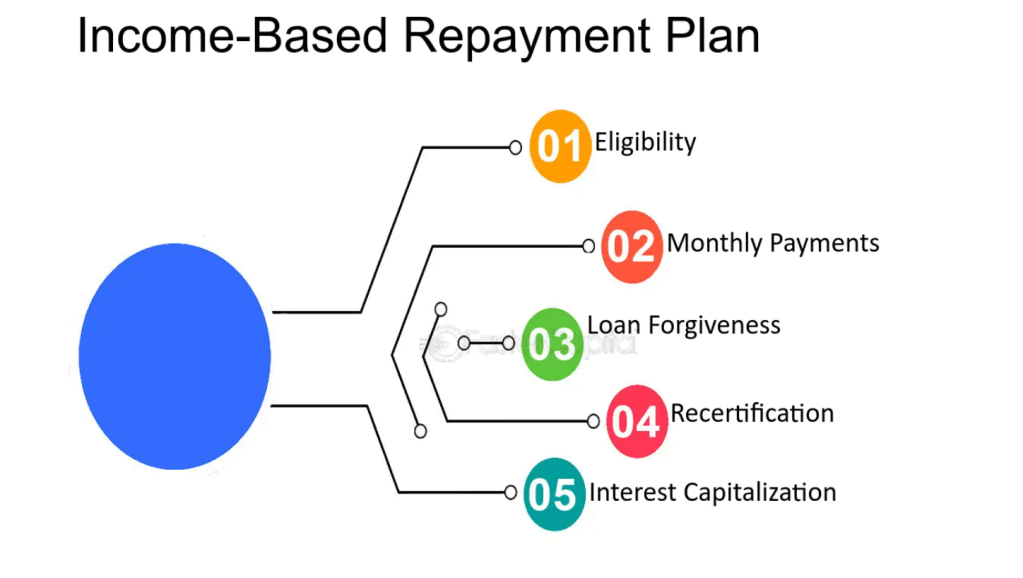
How Income-Based Repayment Works?
And here’s the genius bit. IBR determines your payment based on a percentage of your discretionary income expenses. Your discretionary income is the difference between your adjusted gross income (AGI) and 150% of the federal poverty guideline for your household size.
The payment structure depends on when you first borrowed:
- Original IBR: 15% of discretionary income (25-year forgiveness)
- New Borrower IBR: 10% of discretionary income (20-year forgiveness)
Who is Eligible for IBR Plans?
There is, however, an eligibility criterion, and not everyone can jump on the IBR bandwagon. You need to show some degree of financial hardship, which means your IBR payment must be less than what you would pay under the standard ten-year repayment plan.
The positive news is that most holders of federal student loans qualify for them, particularly if you are:
- A recent graduate with an entry-level job
- Civic-minded service workers
- Individuals going through a temporary financial hardship
- Overspending parents
IBR vs All Other Income-Based Repayment Plans: The Definitive Distinction
Knowing your options is important. This is how IBR compares with other income-driven options:
| Plan Type | Payment Rate | Forgiveness Timeline | New Borrower Date | Most Advantageous For |
|---|---|---|---|---|
| IBR (Original) | 15% of discretionary income | 25 years | Before July 1, 2014 | Older borrowers |
| IBR (New) | 10% of discretionary income | 20 years | After July 1, 2014 | Recent graduates |
| PAYE | 10% of discretionary income | 20 years | Requires partial hardship | Lower-income borrowers |
| REPAYE | 10% of discretionary income | 20/25 years | No hardship requirement | Graduate students |
| ICR | 20% of discretionary income | 25 years | No restrictions | Parent PLUS borrowers |
When IBR Makes Perfect Financial Logic
From what I’ve seen, there are specific scenarios where IBR performs magic. You should strongly think about IBR if:
- Your debt is more than 10% of your income
- You intend to work in public service
- You have a temporarily low income but have good growth potential
- You require financial breathing room to stabilize your finances
IBR may seem unappealing to high-income earners who prefer to pay comfortably to standard payments, or those striving to lower total interest over the loan life.
IBR Eligibility Requirements: What Qualifies You?
Federal Student Loans Eligible Under IBR
IBR is limited to federal student loans. These include:
- Direct Subsidized and Unsubsidized Loans
- Direct PLUS Loans for Graduate Students
- Direct Consolidation Loans
- FFEL Program loans
Private education loans are not eligible for IBR, nor any other federal income-driven repayment plans. This highlights one of the key differences between federal and private loans.
Financial Hardship Criteria
Proving partial financial hardship is required to be eligible for IBR. In this situation, your IBR payment is less than the ten-year repayment plan amount.
As a simple illustration, if you’re required to make a standard payment of $350/month and your IBR payment is calculated at $200/month, you are eligible. The difference represents your financial hardship.
New vs. Original IBR: Understanding the Split
The two divisions of IBR stem from government changes:
Original IBR (borrowers before July 2014):
- 15% of discretionary income
- Forgiveness in 25 years
- Available to all eligible borrowers
New Borrower IBR (after July 2014):
- 10% of discretionary income
- Forgiveness in 20 years
- Exclusively for individuals without a federal loan history before July 1, 2014
How IBR Payment Calculations Work (With Real Examples)
Your Discretionary Income Formula
Discretionary income forms the foundation of IBR calculations. Here is the formula:
Discretionary Income = AGI – (150% × Federal Poverty Guideline)
For 2025, the federal poverty guideline for a single individual is $15,060, meaning 150% equals $22,590.
Step-by-Step IBR Payment Calculation
Allow me to illustrate with a case study:
Sarah’s Situation:
- Annual income: $45,000
- Family size: 1 (single)
- Federal loan debt: $35,000
- Post-2014 new borrower
Calculation Process:
- Discretionary income = $45,000 – $22,590 = $22,410
- IBR payment = $22,410 × 10% = $2,241 annually
- Monthly payment = $2,241 ÷ 12 = $187/month
The previously mentioned standard monthly payment of around $350, when compared to the adjusted payments, highlights the reduced financial strain placed by IBR.
Payment Cap Protections
Here’s something crucial: IBR payments are capped at what you would pay on the standard 10-year plan. This protective feature ensures that you will not pay more than the capped amount, even if your income rises significantly.
The IBR Application Process: Your Step-by-Step Guide
Documentation Requirements Checklist
Before applying, ensure these documents are ready:
- Last annual tax return or tax transcript
- Last three months’ pay stubs
- Document showing family size (marriage certificate or birth certificates)
- Other income supporting documents (unemployment or disability payments)
Where and How to Apply for IBR
Options to apply are:
- StudentAid.gov (most accessible and quickest)
- The loan servicer’s website
- Paper application sent to the appropriate loan servicer
Without a doubt, I prefer advising to go online. It’s the fastest, error-free method with instant confirmation of submission.
Expected Timeframes and What to Anticipate
- Average processing duration: 2-4 weeks
- During processing: Continue making your normal payments
- Upon approval, the reduced payment amount will be implemented the following month
Pro tip: Apply well in advance. Do not wait until you’re already feeling the financial pressure.
Annual IBR Recertification: Stay on Track
An Annual Milestone That Must Not Be Overlooked
Every year, you are required to recertify your income and household size. Your loan servicer begins sending notifications 60 days prior; however, the responsibility still rests on you.
Failure to meet recertification deadlines incurs penalties, including:
- Returning to standard payments of the 10-year repayment plan
- Adding unpaid interest capitalization to the principal balance
- Losing IBR benefits until recertification is achieved
Essential Documents Needed for Recertification
Documents needed include:
- Updated tax returns from the previous year
- Recent pay stubs (if employment has changed)
- Family structure documentation for any changes
- Confirmation of employment status
These processes can be streamlined through online portals, resulting in submission windows of 10-15 minutes; however, neglecting to submit can have dire consequences.
IBR Loan Forgiveness: Light at the End of the Tunnel
Understanding the IBR Forgiveness Mechanism
The balance owing is forgiven after the borrower has made qualifying payments for 20-25 years (depending on your version of IBR). All forgiven balances, including unpaid principal and accrued interest, will be discharged.
Qualifying payments include:
- Payments made under IBR
- Payments made under other income-driven repayment plans
- Economic hardship deferment periods (not exceeding three years)
The Tax Bomb You Need to Know About
Here’s the catch: under IBR repayment plans, the forgiven debt is treated as taxable income. So if $30,000 is forgiven, you will pay taxes as if that amount was added to your income.
Example: If $30,000 is forgiven and you’re in the 22% tax bracket, you’d owe approximately $6,600. This “tax bomb” can cause significant financial stress if unprepared.
Planning strategies:
- Set aside funds for taxes in a separate account
- Consider paying over the minimum to lessen the amount forgiven
- Determine eligibility for Public Service Loan Forgiveness (PSLF) and pursue it if applicable
IBR Pros and Cons: Complete Analysis
Major Benefits of Income-Based Repayment
- Immediate financial relief: Reduced monthly obligations free up funds for other priorities
- Flexible payment adjustments: Payments adjust automatically with income changes
- Eventual loan forgiveness: Full discharge available after 20-25 years
- Unemployment protection: During difficult circumstances, payments can drop to $0
- Interest subsidy: The government pays part of your interest in some cases
Potential Drawbacks to Consider Carefully
- Higher total interest costs: Lower payments over extended periods equal increased interest expenses
- Extended repayment term: 20-25 years, opposed to a 10-year standard term
- Annual recertification burden: Administrative tasks and deadlines every year
- Tax implications: Forgiven debts are treated as taxable income
- Greater complexity: More complicated compared to straightforward repayment plans
Real-World Case Study: Maria’s IBR Journey
With a bachelor’s degree in hand, Maria had $45,000 in federal student loan debt and worked as a social worker earning $38,000 yearly. She was estimated to pay $460/month on a standard repayment plan, which was not budget-feasible considering her income.
With IBR:
- Monthly payment: $127
- Extra cash flow: $333/month
- Savings were utilized for an emergency fund and professional development
- After five years, Maria’s income increased, but her payments remained manageable
“IBR gave me breathing room to build my career without drowning in debt,” Maria shared. “I had the option of taking a lower-paying job within my field instead of abandoning my passion.”
IBR During Major Life Changes
Marriage and IBR: What Changes?
Marital status does change your IBR calculation, but how you file taxes impacts it far more:
- Married Filing Jointly: Both spouses’ incomes are used for payment calculation
- Married Filing Separately: Only your income qualifies; however, you forgo specific tax advantages
Many couples prefer filing separately even when it increases their overall tax burden, as it keeps IBR payments lower.
Job Loss and IBR Protection
In the event of job loss, IBR offers critical protections:
- Notify your servicer of your income change immediately
- Payments could scale down to $0 with no earnings
- Unemployment compensation is considered income for IBR calculations
- An updated payment calculation can be requested at any time
Income Changes: When to Update
With significant improvements or reductions in income, you don’t have to wait for annual recertification. Contact your servicer if:
- Your employment status changes (including pay cuts)
- Your income increases by more than 10%
- Your household size changes due to marriage, divorce, or children
IBR Success Stories and Common Mistakes
Success Story: From Overwhelmed to Empowered
James, a nonprofit worker, was managing a student loan payment of $520/month alongside a $60,000 salary. Upon switching to IBR, his payment decreased to $180/month.
“The additional $340 per month transformed my life,” James explained. “It allowed me to finally save for emergencies, contribute to my 401(k), and even budget for a vacation. IBR didn’t just help with my loans—it improved my entire financial picture.”
Common IBR Mistakes That Cost Money
Mistake 1: Missing recertification deadlines. Solution: Set calendar reminders 90 days before the deadline
Mistake 2: Failing to report changes in family size. Solution: Notify the servicer immediately when you marry, divorce, or have children
Mistake 3: Ignoring payment cap benefits. Solution: Understand that payments won’t exceed the 10-year standard amount
Mistake 4: Overlooking tax consequences. Solution: Start saving to cover potential tax liability on forgiven debt
Getting Started with IBR Today
Your Immediate Action Plan
Step 1: Contact your loan servicer to check IBR eligibility. Step 2: Collect necessary documentation (tax returns, pay stubs, family info.) Step 3: Apply online at StudentAid.gov. Step 4: Set up autopay to receive a 0.25% interest rate reduction. Step 5: Mark your calendar for next year’s recertification
Professional Help Resources
If you require assistance with IBR:
- National Student Loan Data System (NSLDS): Track all your federal loans
- Student Loan Borrower Assistance Project: Free legal assistance
- Consumer Financial Protection Bureau: Complaint resolution
- Non-profit credit counseling agencies: Budget and debt management
Tools and Calculators
- Federal Student Aid Repayment Estimator: Compare all payment options
- IBR Payment Calculator: Estimate your monthly payment
- Loan Simulator: Model different scenarios and strategies
Conclusion: For federal student loan borrowers facing burdensome monthly payment obligations, Income-Based Repayment can provide crucial financial relief. While IBR has its shortcomings—it increases total interest costs and requires ongoing maintenance—it offers flexibility and eventual forgiveness that can make the difference between financial stability and overwhelming debt.
Be strategic and analyze scenarios, evaluate your career path, and consider long-term implications before committing to IBR. When deployed with precision, it becomes a powerful tool that has enabled millions of borrowers to regain control of their student loan debt and build stronger financial futures.
Frequently Asked Questions
Who qualifies for IBR?
You qualify for IBR if you have eligible federal student loans and demonstrate partial financial hardship. This means your IBR payment would be less than your standard 10-year payment. Most borrowers with federal loans qualify, particularly those with entry-level incomes or large debt loads.
How is the monthly payment calculated under IBR?
IBR payments are calculated as either 10% or 15% of your discretionary income (income minus 150% of the federal poverty guideline), divided by 12 months. New borrowers after July 1, 2014, pay 10% with 20-year forgiveness, while earlier borrowers pay 15% with 25-year forgiveness.
Does IBR affect my credit score?
IBR itself doesn’t directly impact your credit score. However, making consistent on-time IBR payments will help build a positive payment history. If you were previously missing payments before switching to IBR, the lower payments can help you get back on track and improve your credit over time.
Can I switch from another repayment plan to IBR?
Yes, you can switch to IBR from any other federal repayment plan, including standard, graduated, or other income-driven plans. Contact your loan servicer to request the change. You’ll need to complete an application and provide income documentation, just like a new IBR applicant.
What happens if I miss my IBR recertification deadline?
Missing your recertification deadline causes your payment to revert to the standard 10-year amount, and any unpaid interest gets capitalized (added to your principal balance). You’ll need to complete the recertification process to restore your IBR benefits. Set calendar reminders to avoid this costly mistake.
Can I make extra payments while on IBR?
Absolutely! Making extra payments while on IBR can significantly reduce your total interest costs and help you pay off loans faster. Specify that extra payments should go toward principal, not future payments, to maximize the benefit.
How does IBR work with loan consolidation?
If you consolidate your loans through a Direct Consolidation Loan, you can apply for IBR on the new consolidated loan. However, consolidation resets your payment count for forgiveness purposes, so consider the timing carefully if you’re close to the 20-25-year forgiveness mark.
 Site Title
Leave a comment