• What is Wire Transfer? Process, Fees & Top Tips Guide for 2025

    Explore the wire transfer process, associated fees, and expert tips to make fast, secure international transactions in 2025.

    What Is Wire Transfer? Everything You Need to Know About Efficient and Safe Money Transfers in 2025

    Imagine this scenario: You have to send your cousin based in Australia a whopping $15,000 for their wedding happening in a week. Traditional methods like banking apps won’t work, and waiting for a check to clear isn’t an option. During such times, wire transfers are able to come to the rescue. They are a financial lifesaver. There is no safer, faster, or more convenient way to switch money than through wire transfers. Banks around the globe process more than $5 trillion in wire transfers every single day.

    During the past few years, I have helped countless individuals deal with international payments. Armed with such experience, I can confidently say that wires aren’t just helpful; they’re necessary. It does not matter if you are purchasing estate in a different country, supporting relatives who live abroad, or are dealing with important business payments, knowing how to properly do a wire transfer is crucial. A little knowledge can save you hundreds of dollars and eliminate loads of stress.

    By the end of this guide, I hope to help you understand everything there is to know about wire transfers in 2025. Through this guide, I will take you through the fundamentals as well as the additional protective components so that you can understand the reason why millions of individuals wire funds each calendar year.

    Understanding Wire Transfers: An Electronic Method of Sending Money

    What is a wire transfer? It is an electronically facilitated method of sending money between two (or more) bank accounts. It is like sending a telegram; in this case, financial telegrams, where the funds are sent using secure banking channels and reach their destination in hours/days instead of weeks.

    Compared to other forms of payment, wire transfers fund instantly. Fund movement through a bank is termed a wire transfer. Sending a wire transfer leaves your account with a charge and travels through a system of correspondent banks until it reaches the destination account. Instant fund movement, no waiting period, no holds, no reversals.

    Wire transfers are marked for their strong advantages in speed and certainty of outcomes. Bounced checks and disputed payments are common in traditional methods like checks and credit cards. This is where wire transfers gain the upper hand, as the minute these transactions are made, they are irrevocable ‘good funds’.

    How Wire Transfers Work: The Journey Of Your Money

    Initiating a wire transfer is like sending a secure message to your bank with the precise instructions, “Move this exact sum of money to this account”. The bank wire transfer process unfolds as follows:

    First, the bank makes sure the customer has the correct balance and permissions to send the specified amount. Then, they assemble an electronic document encapsulating all transfer details, including the receiver’s name, the exact amount to be sent, the transaction’s purpose, and detailed routing instructions. This document is sent through secure banking networks like SWIFT (Society for Worldwide Interbank Financial Telecommunication) for international transfers or Fedwire for domestic US transfers.

    For international transfers, there may be multiple correspondent banks that your money has to go through to reach its destination. Each bank in the chain verifies the transaction and forwards it to the next institution. This is why international wire transfers can take 1-5 business days, while domestic wires are often completed within hours.

    The receiving bank will get an alert with the account number where the funds are supposed to be wired. The bank confirms all the entered details and then wires the funds to the account. At this stage, the transfer is irreversible.

    Types of Wire Transfers: Choosing Your Path

    Comprehending the available wire transfer options will assist you in making the most suitable choice for your requirements. Here are the key classifications:

    Domestic vs International Wire Transfer

    Domestic wire transfers utilize national payment networks within a single country. In the US, these transfers usually cost between $15 and $ 50 and are completed within a few hours during business days. They are ideal for urgent payments, real estate deals, or substantial payments needing instantaneous processing within the country.

    International wire transfers are more expensive ($35-80 at traditional banks) due to compliance considerations with correspondent banking relationships, which are necessary due to border crossing and currency exchange, resulting in a longer time frame of 1-5 days. Nonetheless, they remain the quickest method of sending large sums of money abroad.

    Bank-to-Bank vs Online Wire Transfer Services

    Traditional banks have a rich history in wire transfer services, but at a cost. This gap created a space for online platforms such as Wise, Remitly, and Western Union to offer better alternatives that are faster and cheaper.

    Provider TypeSpeedCostBest For
    Traditional Banks1-5 days$35-80Large amounts, established relationships
    Online ServicesMinutes-24 hours$5-25Regular transfers, better rates
    Credit Unions1-3 days$15-40Members seeking lower fees

    Wire Transfer Fees: What You’ll Actually Pay

    The fee structure is one of the most surprising elements for new users of wire transfer fees. Not only do banks hit you with a single charge, but they will also hit you with multiple charges throughout the entire process.

    The Complete Fee Breakdown

    Sending fees are what your bank charges to initiate the transfer. These charges start with $15 for domestic transfers and $50+ for international transfers. While credit unions tend to charge less, major banks like Chase or Bank of America are on the higher end of the spectrum.

    Receiving fees is often overlooked. The recipient’s bank may charge $10-20 just to receive the incoming wire transfer. There are also international transfers, which have higher receiving fees, going up to $30.

    Intermediary bank fees come into play when your transfer uses other banks to transfer money. Each bank in the chain can deduct $10-25 for every transfer. This is why a $1,000 international wire transfer may arrive as $940.

    Costs of conversion during exchange remain the most significant concealed cost. Banks usually provide exchange rates that are 3–4% less favorable than the actual market value. Transferring $10,000 incurs an additional “markup fee” of approximately $300 to $400.

    Smart Strategies To Reduce Wire Transfer Expenses

    Over the years, I’ve learned several tips to reduce wire transfer expenses. Before sending a transfer, consider timing. Transfers sent early in the morning tend to avoid overnight holds, while Fridays should be avoided altogether unless the goal is to have funds idling until the weekend is done.

    Consider using the internet for regular transfers. When you transfer money, Fairexpay is one of many online services that use real exchange rates and charge a fee that is closer to the actual value instead of marked-up fees. For occasional large transfers, compare fees as some banks offer premium rates to loyal customers.

    If a large amount is to be sent and you are a long-time bank customer, don’t be afraid to negotiate. Many banks tend to lower or completely remove fees, especially for transfers exceeding $25,000.

    Wire Transfer Security: Keeping Your Money Safe

    Wire transfers hold a high level of security but come with the downside of being non-reversible. This makes the process reliable and at the same time, risky. Having a strong understanding of wire transfer security risks helps individuals protect themselves from the few threats that exist.

    Security Layers of Banking Transactions

    For wire transfers, banks implement multiple layers of security. Multi-factor authentication can consist of passwords, security tokens, or even biometric verification. Your transfer data is also encrypted during its movement within the banking networks. Automatic flagging for suspicious transactions is handled by compliance monitoring systems.

    The SWIFT network is, without a doubt, one of the most secure financial systems globally. Each message sent is encrypted, authenticated, and traceable. A bank’s record-keeping of wire transfers creates an audit trail that is extremely detailed, making manipulation nearly impossible.

    Protecting Yourself Against Wire Transfer Fraud

    Because wire transfers are irreversible, scammers continue to target them despite robust security measures. The most prevalent wire transfer scams are:

    Romance scams consist of individuals who build an online relationship, then request money, citing emergencies. Business email compromise occurs when hackers intercept legitimate business correspondence and reroute the payment to fake accounts.

    Fake emergency requests usually come from people claiming to be relatives stranded overseas and in need of help. These scammers create urgency to escape the verification loop.

    My approach is never to send wire transfers to people you’ve never met face-to-face. If you become pressured to send money almost instantly, it is 100% a scam. Real recipients know the severity that comes with wire transfers and won’t try to rush you.

    Modern Alternatives: Beyond Traditional Wire Transfers

    A tremendous amount of advancement has occurred within the financial industry, and there are now several options that work better than the wire transfers offered by your banks. Allow me to guide you through the options that are most useful to you.

    Digital Payment Platforms

    Services like Wise (formerly TransferWise) have changed how to transfer money internationally. Their charge of fees is straightforward, and unlike banks, they complete transfers far quicker than other institutions, often within a day. With Wise, if you were to transfer $5,000 internationally, as opposed to going through a traditional bank, you could save yourself between $200-300.

    Western Union still offers its services alongside its new digital platform, which makes it very useful for sending money to remote countries. Remitly also focuses on sending smaller amounts of money to developing countries.

    When Wire Transfers Still Make Sense

    Regardless of the new trends, some individuals still prefer going through wire transfers due to the options that they provide. For example, in real estate transactions, wire transfers provide concrete safety guarantees that no other method can provide. Corporate settlements above $50,000 are also covered by correspondent banking services.

    Sometimes there are urgent situations that require wire transfer time guarantees and demand higher fees, like sending money that needs to be delivered same day. These payments work best for businesses and governmental agencies that often refuse to accept other forms of payment.

    Step-by-Step Wire Transfer Process

    Allow me to assist you in understanding how to send a wire transfer. The process may appear challenging at first, but it is highly simplistic when broken down into steps.

    Required Information Checklist

    Collect the following primary pieces of information before sending a wire transfer:

    Recipient Information:

    • Complete legal name as it appears on the bank account
    • Residential address
    • Phone contact
    • Account number

    Bank Details:

    • Name of the bank and office location
    • Bank’s complete address
    • SWIFT code (for international transfers)
    • Routing number (for domestic transfers within the US)
    • Details of any intermediary bank (if applicable)

    Transfer Information:

    • Exact figures to be sent
    • Stated purpose of payment
    • Updated contact details

    Bank Wire Transfer Procedures

    Go to a branch or use online banking. For first-time users, I recommend walking into the branch as staff are able to assist you throughout the wire transfer and prevent mistakes prior to payment submission.

    Complete all sections of the wire transfer form without omissions. Pay special attention to numbers and codes associated with accounts.

    Before confirming (especially for international transfers), check on the charges and exchange rate that are applicable, along with the wire transfer time it would take to process. Ensure you have payment receipts, as they are key documents needed for tracking.

    Real-World Wire Transfer Examples

    In this segment, I will explain step by step the practical applications of wire transfers with specific examples.

    Case Study: Buying International Property

    For instance, let us say Sarah wanted to purchase a vacation home in Portugal, which costs €300,000. The wire transferring fee from her US bank would be $75 with an additional 4% currency markup, resulting in around $12,800. Wise, however, offered a way better deal at a flat fee of $1,200. This resulted in savings of over $11,000.

    Unlike her bank, which took 5 business days, Sarah’s new service was able to transfer the money within 2 days. She also received real-time updates about her transfer status, with the ability to track exactly when the funds were sent. The Portuguese real estate agent confirmed receipt instantaneously, allowing the purchase to proceed without any delays.

    Case Study: Supporting Family in Emergency Situations

    Mark’s brother had to be hospitalized in Thailand, and he needed $8,000 as soon as possible for medical services. Traditional banks were not able to provide same-day delivery because of the time zone difference. Mark decided to use Western Union’s bank-to-bank service. Regardless of the 12-hour timezone difference, the funds were delivered within 4 hours.

    Although the fees were higher ($85 as compared to $45 for normal wire transfers), avoiding the hassle was well worth it. This allowed Mark’s brother to focus fully on recovery without worrying about payment logistics

    Troubleshooting Common Wire Transfer Issues

    Problems may occur despite thorough planning for wire transfers. Here’s how to address some of the most common issues:

    Transfer Hold Issues

    Unverified information, compliance holds, and transfers requested on weekends or holidays tend to be the most common reasons wire transfers are delayed. For international payments, additional anti-money laundering scrutiny applies.

    When payment transfers are delayed, always start with the sending bank. They have the capability to track the transfer and see where it has broken down. Make sure you have the wire transfer receipt handy, as you will need the reference number for any inquiries.

    Incorrect Recipient Information

    Incorrect recipient information is every wire transfer user’s nightmare. Transferring money to the wrong account is almost impossible to reverse. However, if you are able to identify the issue within a few hours, there is still some hope, although success isn’t guaranteed.

    As with most issues, prevention is key. In this case, ensure that the information you are provided with is verified independently. Rather than trusting written instructions alone, call the person who provided you with the information to confirm details.

    The Future of Wire Transfers in 2025

    The ecosystem of wire transfer is changing at a breathtaking rate. CBDC systems available in some countries are able to omit the traditional delays resulting from correspondent banking, which could help CBDCs make international transfers cheaper and quicker than ever.

    Some banks are adopting blockchain technology for monitoring wire transfers to decrease settlement times. While this technology is currently operating in the background, it is expected to become more accessible to consumers in the following years.

    AI technologies are refining fraud detection and compliance enforcement. Using AI technologies is advantageous because they can recognize suspicious activities and cancel likely fraudulent transfers before completion, providing better protection for everyone.

    Expert Tips for Wire Transfer Success

    Through my extensive experience assisting people with global transfers, I have identified some strategies that work best:

    Time your transfers strategically. International wire transfers are best sent between Monday and Wednesday to avoid weekend delays. Also, pay attention to time zones. Transfers initiated from New York on Friday afternoons might not execute until Monday in Asia.

    Build relationships with your transfer service providers. If you make recurring transfers, cultivate networks with particular representatives who know your preferences. They are often able to facilitate transfers or give discounted rates to loyal clients.

    Maintain accurate records for all transfers. Keep detailed information, capture the objective and relevant recipient information alongside confirmations. This data aids in tax filing and presents less possibility for disputes down the line.

    Consider currency hedging for large international payments. Exchange rates can fluctuate significantly while the transaction is being processed. Certain companies provide locks on the exchange rate that safeguard you from negative movements.

    Conclusion:

    As of 2025, wire transfers remain one of the most reliable ways to transfer funds swiftly and securely. While the fees can be substantial, the speed, security, and finality of transactions make them invaluable for critical financial transfers. Whether using traditional banks or modern online services, having a good grasp of the process allows you to make educated choices and avoid expensive errors.

    For optimal results, remember to research all available options, compare fees and exchange rates, and verify recipient details before commencing the transaction. With adequate planning, wire transfers can be an essential tool for managing your finances in our interconnected world.

    Frequently Asked Questions

    What is a wire transfer?

    A wire transfer is an electronic method of sending money from one bank to another through secure banking channels. Unlike checks or ACH payments, wire transfers execute real-time movement of funds and are irreversible once processed.

    How long does a wire transfer take?

    During business days, domestic wire transfers can be completed within a few hours. International wire transfers vary between 1 to 5 business days based on the destination country, relationships with correspondent banks, and regulatory compliance requirements.

    Are wire transfers safe?

    Indeed, wire transfers are highly secure because of the various security measures in place, such as encryption, authentication, and oversight by regulatory authorities. However, wire transfers are permanent, so you must double-check recipient details before sending.

    What are the fees associated with wire transfers?

    Providers and destinations impact fees. Domestic transfers typically cost $15-50, while international transfers through traditional banks fall within the range of $35-80. Additional costs include receiving fees ($10-30) and currency conversion markups (2-4%).

    What details are needed to send a wire transfer?

    For the recipient, a complete name, address, bank account number, and corresponding bank details are required. For international transfers, a SWIFT code is needed, while domestic ones require a routing number. Certain payments also require intermediary bank details and payment purpose documentation.

    Can I cancel a wire transfer after sending it?

    Typically, wire transfers cannot be undone once processed. In some scenarios, however, it may be possible to cancel within a few hours of sending, as there is a window during which transactions can be blocked before reaching the recipient’s bank.

    What’s the difference between wire transfers and ACH transfers?

    Wire transfers are instant, permanent, and cost $15-80, while ACH transfers are slower (1-3 days), reversible, and cheaper ($0-3). Wire transfers use different networks and provide guaranteed funds availability, making them more suitable for large or time-sensitive payments.

    Are there limits on wire transfer amounts?

    Most banks do not impose a maximum limit on wire transfer amounts, though they tend to set a minimum threshold between $100 to $500. For larger transfers, additional documentation and compliance checks will likely be necessary, especially for payments exceeding $10,000.


  • What Is Remittance? Meaning & How It Works

    Discover the meaning of remittance, how it works, and its role in sending money abroad safely and efficiently.

    What Is Remittance: A Comprehensive Guide for International Transfers

    In this era of globalization, remittances play a crucial role in supporting families across borders. A remittance is not merely about sending money; it represents love, social duties, and family bonds that help meet basic needs, including education, medical treatment, shelter, and other daily requirements.

    This guide covers every aspect of remittances, including definitions and practical advice on sending and receiving money from abroad.

    What is a Remittance? Understanding the Basics

    A remittance refers to funds transferred from one person to another across borders via international payments. The term comes from the word “remit,” which means “send back.” While any transaction could be a remittance, the term is most broadly associated with international transfers, primarily those sent by expatriate workers to their relatives in their home country.

    Remittances are financial bridges connecting people separated by geographical distances but linked by familial or friendship ties.

    Types of Remittances

    Remittances can be classified into two broad categories:

    1. Personal Remittances

    These are payments made between individuals, usually family members, such as in the following scenarios:

    • A nurse residing in the US wiring funds to her children located in India
    • IT employees from Germany supporting their ageing parents in India
    • Migrant workers assisting broader family members who used to live in the country of their migration

    a. Person-to-Business (P2B) Remittances

    Transfers made by individuals to a business entity or a designated service company offshore. These encompass:

    Tuition Fee Payments

    • International students remitting tuition fees to their host institutions
    • Funds sent by parents to aid their children’s education abroad
    • Payment for related costs, which include residence, books, and other academic materials

    Healthcare Payments

    • Patients remitting for healthcare services not available in their countries of residence
    • Medical tourism payments for surgeries, specialized treatments, or consultations
    • Insurance reimbursements for services rendered abroad

    Travel Remittances

    • Remittances sent for travel and holiday expenses
    • Emergency aid for persons travelling overseas
    • Pre-funding of travel cards/accounts for expected upcoming trips

    2. Business remittances

    • Payments through businesses across borders, such as an Australian company paying its supplier in Vietnam.
    • Real estate purchases or investments
    • Investing in foreign companies or startups
    • Payment of goods and services rendered by offshore suppliers
    • Payment for professional services rendered (legal, consulting, etc.)

    Remittances tell a fundamentally human story. Consider Ahmed, a software engineer working in Dubai, who sends $1,200 every semester to cover his daughter’s tuition fees and living expenses as she pursues her engineering degree at a university in Canada. Each month, he also transfers an additional $500 to help with her accommodation, books, and daily expenses. Multiplied by millions of parents globally supporting their children’s education abroad, this simple act forms an enormous economic force that often surpasses official development aid.

    Remittances and Their Global Impact

    The financial scale of remittances is staggering. According to the World Bank, officially recorded remittances sent to low and middle-income countries reached $626 billion in 2022, over triple the amount of official development assistance and in many cases exceeding foreign direct investment.

    1. Economic Impact as Percentage of GDP

    Some countries rely heavily on remittances as part of their GDP:

    • Tonga: 43.9% of GDP
    • Lebanon: 38% of GDP
    • El Salvador: 26.2% of GDP
    • Nepal: 24.8% of GDP
    • Honduras: 23.4% of GDP

    2. Largest Remittance Recipients by Volume

    • India: $100 billion
    • Mexico: $60 billion
    • China: $51 billion
    • Philippines: $38 billion
    • Pakistan: $30 billion

    Source: World Economic Forum

    “Remittances are a lifeline for developing economies and vulnerable populations, providing a critical buffer against economic shocks and supporting household consumption and investment.” – World Bank Group

    3. Social Impacts of Remittances

    Beyond economic impacts, remittances have far-reaching social effects:

    • Poverty eradication: Directly raising household income above poverty lines
    • Educational attainment: Funding tuition and school supplies, allowing children to remain enrolled
    • Access to healthcare: Paying for medical care and improving health outcomes
    • Improved housing: Funding repairs, renovations, and home purchases
    • Entrepreneurship: Stimulating small business creation through local capital infusions

    Remarkably, remittances often persist through economic downturns. During crises, migrants frequently send more money home rather than less, contrary to expectations.

    How Remittance Systems Work: Following the Money

    The basic remittance process follows a similar pattern regardless of method:

    1. Initiation: The sender (remitter) provides payment details and funds (including fees) to a service provider
    2. Processing: The service provider processes the transaction, including currency conversion
    3. Transmission: Transfer instructions are sent through the provider’s network
    4. Distribution: The recipient receives funds through the designated method (bank deposit, cash pickup, mobile wallet, etc.)
    5. Confirmation: The sender receives confirmation of successful delivery

    Remittance Channels

    Bank Transfers

    Bank-to-bank transfers often involve the SWIFT network (Society for Worldwide Interbank Financial Telecommunication). While secure, they typically have higher fees and can take several business days to process.

    Money Transfer Operators (MTOs)

    Companies like Western Union, MoneyGram, and Ria offer cash-to-cash transfers through global networks. MTOs are often faster than banks, sometimes providing transfers in as little as 10 minutes and serving regions with limited banking access.

    Online Remittance Services

    Digital-native companies like Remitly, WorldRemit, and Fairexpay money transfer services are disrupting the market with lower fees and competitive exchange rates. Funds are typically deposited directly into the recipient’s bank account or mobile wallet.

    Mobile Money Services

    In areas with limited bank access but available mobile service, mobile money platforms have transformed remittances. Services like M-Pesa (Kenya), GCash (Philippines), and bKash (Bangladesh) enable direct deposits to mobile numbers, which can then be spent, withdrawn as cash, or used for bills.

    M-Pesa alone has helped lift approximately 2% of Kenyan households out of extreme poverty, with especially strong effects among women-headed households.

    Informal Channels

    A significant portion of remittances flows through informal services operating on trust networks without legal financial structures, such as hawala (Middle East/South Asia) or hundi (India). While these may offer lower costs and reach remote areas, they lack consumer protections and pose potential risks.

    Inward vs. Outward Remittances

    Remittances are classified based on their direction relative to a specific country:

    Inward Remittances

    Funds are coming into a country from overseas. From the receiving country’s perspective, this represents an inflow of currency.

    Example: If you’re in India and your brother working in the UAE sends you money, that’s an inward remittance from India’s perspective.

    Characteristics:

    • Less stringent documentation requirements
    • More favorable foreign exchange rates
    • Fewer restrictions on fund usage
    • Possible tax exemptions in some jurisdictions

    Outward Remittances

    Money sent from within a country to a recipient abroad represents a currency outflow from the sending country’s perspective.

    Example: If you’re working in the UAE and send money to your parents in India, that’s an outward remittance from the UAE’s perspective – money flowing out of the UAE to another country.

    Characteristics:

    • Stricter documentation requirements
    • Regulatory limits on transaction amounts
    • Purpose declarations required
    • Potential tax implications or reporting obligations

    Countries tend to be more restrictive with outward remittances, especially those with currency controls or fixed exchange rates. For instance, China restricts individuals to $50,000 in outward remittances annually, while India permits up to $250,000 per financial year under its Liberalized Remittance Scheme.

    How to Send a Remittance: Step-by-Step Guide

    1. Research Your Options

    Evaluate service providers based on:

    • Overall price including exchange rate markup
    • Transfer speed
    • Delivery method accessibility at the destination
    • Coverage in the recipient’s location
    • Reliability and reputation
    • User satisfaction with digital options

    Comparison sites like Monito and Finder can help find suitable options.

    2. Compile Essential Information

    You’ll typically need:

    • Recipient’s full legal name
    • Destination country and currency
    • For bank deposits: Bank name, account number, branch information, routing codes (SWIFT/BIC, IBAN)
    • For cash pickup: Recipient’s phone number and address
    • For mobile money: Recipient’s mobile wallet number

    3. Prepare Relevant Documentation

    Depending on the amount and destination, you may need:

    • Identification document (Aadhar, PAN card, passport, driver’s license)
    • Source of funds documentation for large amounts
    • Remittance application form

    4. Complete the Transfer Request

    Following the service provider’s procedures:

    • Enter recipient information
    • Specify the amount to send
    • Review the exchange rate and fees
    • Provide payment method (bank account, card, cash)
    • Complete any verification requirements

    5. Monitor the Transfer

    Most providers offer tracking options:

    • Reference or tracking number
    • Status checks via app or website
    • SMS or email notifications
    • Customer service contact for issues

    6. Inform the Recipient

    Let them know:

    • Payment is being processed.
    • Expected arrival time
    • Any reference numbers needed
    • Collection requirements (identification, etc.)

    7. Verify Receipt

    Ensure the payment was received and the amount matches exactly. If problems occur, immediately contact your service provider with tracking details.

    Remittances and Financial Inclusion

    Remittances foster financial inclusion by enabling the productive use of technology in underbanked communities:

    • Savings accounts: Recipients are motivated to save portions of the received funds
    • Credit history development: Regular remittances help establish financial records supporting loan applications
    • Insurance products: Some providers bundle remittance services with life, health, or property insurance
    • Investment opportunities: Remittances provide capital for education, micro-investments, or future funding

    Countries with significant remittance inflows tend to experience corresponding increases in bank account ownership and formal savings. In India, adult bank account ownership rose from 53% to 78% between 2014 and 2021.

    Common Issues and Solutions

    Transfer Delays

    Problem: Delayed arrival.

    Solutions:

    • Choose faster (though more expensive) options
    • Avoid initiating transfers during weekends or holidays
    • Provide complete recipient details
    • Use tracking systems to monitor progress

    High Costs

    Problem: Excessive fees and unfavorable exchange rates.

    Solutions:

    • Compare multiple providers, including exchange rate markups
    • Consolidate smaller transfers into larger ones
    • Look for promotional offers
    • Consider Fairex remitted with lower pricing

    Transfer Rejections

    Problem: Transactions are getting rejected.

    Solutions:

    • Double-check all details for accuracy
    • Verify that the recipient account can accept foreign transfers
    • Ensure purpose codes or declarations are correctly completed
    • Document all attempts and communications

    Exchange Rate Fluctuations

    Problem: Rate changes between initiation and receipt reduce transfer value.

    Solutions:

    • Use providers offering guaranteed rates
    • Monitor exchange rates and transfer during favorable periods
    • Consider multiple smaller transfers to average out rate fluctuations

    Fraud and Scams

    Problem: Fraudulent activities targeting senders and recipients.

    Solutions:

    • Use only licensed and regulated service providers
    • Share transfer codes only with intended recipients
    • Verify unexpected transfer requests
    • Confirm changes to recipient information through secure channels

    When issues arise, document everything and contact the service provider immediately.

    Conclusion: Remittances as Financial Bridges

    Remittances represent more than just money transfers; they embody love, bonds, and responsibility. They fund education, healthcare, housing, and dreams worldwide, providing stability during crises and investing in prospects.

    The remittance industry continues to evolve rapidly, driven by new technologies, competition, and changing migration patterns. These trends promise increasingly faster, cheaper, and easier cross-border transfers, whether through digital wallets or traditional bank-to-bank money transfer methods, unlocking greater economic and social benefits.

    Whether you’re a migrant worker supporting family back home, a parent paying for overseas education, or someone helping a friend in another country, understanding remittances empowers you to make smart decisions about international money movement.

    By participating in remittances, you’re engaging in one of the most important forms of global financial exchange, one that connects people, supports lives, and maintains relationships across borders.

    FAQ

    What differentiates a remittance from a bank transfer?

    While all remittances involve transferring money, not all money transfers are remittances. The term “remittance” typically refers to transfers between individuals across national borders, often for family support. Bank transfers are one method of sending remittances, alongside money transfer operators, post offices, mobile money, and informal networks.

    Are remittances subject to taxation?

    Restrictions apply to outward remittances from India, which fall under Tax Collection at Source (TCS), owing to the Liberalised Remittance Scheme (LRS). For remittances over ₹7 lakh in a financial year, a 5% TCS is mandatory (increased for some categories, including foreign tour packages). Conversely, personal remittances sent to individuals in India, like funds sent by relatives from overseas, are exempt from taxes for the recipient except under special circumstances where they may be deemed as taxable income (for instance, salary or fees). Taxes are complicated as they can change due to purpose and amount, which requires the consultation of a tax expert or reviewing the most recent government publications.

    How long does it take to receive a remittance?

    Processing times vary from minutes to days, depending on:

    • Service provider
    • Destination country
    • Payment and delivery methods
    • Verification processes
    • Banking hours and holidays

    Digital transfers to bank accounts typically take 1-3 business days. Cash pickup options may be available within minutes, and mobile money transfers process almost instantly.

    What happens if the recipient details are incorrect?

    If the error is caught during processing, the transfer may be cancelled and returned minus a fee. If only part of the information is wrong (like a misspelled name), the recipient may have trouble collecting the funds. If an account number is invalid but plausible, the money might get stuck until it is resolved through lengthy procedures. Always triple-check recipient information before finalizing transfers.

    Can I cancel a remittance after sending it?

    This varies by case:

    • Some providers allow cancellation if funds haven’t been claimed
    • Cancellation fees may apply during processing
    • Completed transfers generally cannot be cancelled

    Contact your service provider immediately to maximize cancellation chances.

    Are there restrictions on remittance amounts?

    Yes, at multiple levels:

    • Service providers impose transaction limits (cash pickup services typically have lower limits)
    • Sending countries may restrict outward remittances (especially those with currency controls)
    • Receiving countries may impose limits or require additional documentation above certain thresholds
    • Large transfers trigger legal reporting requirements

    Restrictions vary significantly by country and provider.

    What identification is required to send a remittance?

    Most transfers require a government-issued photo ID, such as a passport, driver’s license, or national ID card. Some providers also require proof of address, source of funds documentation (for larger amounts), and information about the transfer’s purpose. Cash transactions typically face stricter requirements than digital transfers from bank accounts.


  • What Is a SWIFT Code? Understanding Bank Identifiers

    Understand what a SWIFT code is, how it works in international transactions, and how to find the correct code for global money transfers.

    SWIFT: Your Complete Guide to International Money Transfers

    Ever wondered why a transfer to your cousin Ana in Barcelona clears in hours rather than days? Or puzzled over those random letters and digits that appear when sending money abroad? Whatever brought you here, the guesswork ends today.

    Maybe your monthly support goes to parents in Manila, vacation deposits land at a Caribbean resort, or you simply want to understand how transfers cross oceans without losing dollars. In each case, the mechanics and the suspense of waiting vanish once you understand SWIFT basics. No confusing acronyms, just practical facts that let you hit “Send” with confidence.

    What Exactly Is SWIFT?

    Imagine WhatsApp, but built for bankers, with military-grade encryption, and handling trillions of dollars before breakfast. The full name—Society for Worldwide Interbank Financial Telecommunication—sounds impressive, but it isn’t what matters when your rent deadline looms.

    Here’s the key takeaway: SWIFT doesn’t carry money itself. It sends bulletproof messages directing one bank to tell another where to find the funds. That distinction saves headaches.

    Think of organizing a surprise party across three continents using only smoke signals. That chaotic relay of half-heard messages is how international banking worked before SWIFT launched in 1973. Today, the system handles over 42 million messages daily, connecting more than 11,000 banks across 200+ countries.

    SWIFT network explained: Why This Matters to You

    When you wire $50 to a college friend or send $5,000 home for a family medical bill, that money travels on SWIFT’s electronic backbone. Understanding how it works helps you:

    • Calculate transfer fees that actually make sense
    • Avoid rookie mistakes that delay payments
    • Find the fastest route for your money
    • Include the right details so transactions clear smoothly

    SWIFT vs BIC: SWIFT Codes: Your Bank’s Global Address

    SWIFT payment system: Every branch handling international payments needs an address, or funds drift into cyberspace. That unique identifier is the bank’s SWIFT code (also called a BIC code; the terms are interchangeable).

    SWIFT code format: Deciphering a SWIFT Code

    A SWIFT code compresses an entire financial institution into 8 to 11 characters:

    • First 4 letters: Bank name (CHAS = Chase)
    • Next 2 letters: Country code (US = United States)
    • Next 2 digits: City code (33 = New York)
    • Last 3 characters: Often XXX, indicating the main branch

    Example: CHASUS33XXX = Chase Bank’s main New York office

    SWIFT code example: Popular SWIFT Codes by Bank

    InstitutionCountrySWIFT CodePrimary City
    ChaseUnited StatesCHASUS33New York
    Bank of AmericaUnited StatesBOFAUS3NNew York
    Wells FargoUnited StatesWFBIUS6SSan Francisco
    BarclaysUnited KingdomBARCGB22London
    HSBCHong KongHSBCHKHHHong Kong

    How to find SWIFT code: Finding a SWIFT Code: Five Real-World Tips

    1. Check the bank’s website – Look for “International Transfer” or “Wire Transfer” sections
    2. Log in to online banking – Information often appears under wire transfer requests
    3. Call customer service – Representatives provide codes within minutes
    4. Review bank statements – Many institutions print codes near transaction records
    5. Use the mobile appFairexpay’s International money transfer menus typically display codes.

    Important: Verify the code before submitting. One wrong character can reroute funds to the wrong destination, causing delays and fees.

    How SWIFT works: How Your Money Actually Travels

    Picture this: You’re sending $1,000 to your cousin learning the ropes in London. Here’s the journey your money takes:

    Step 1: You Start the Journey

    Whether at a branch or on your phone, you provide essentials: full name, address, UK account number, SWIFT code, and the amount.

    Step 2: Your Bank Creates the Message

    A simple “Give John $1,000” won’t work. Behind the scenes, a template called MT103 gets filled out with precise details in universal banking language.

    Step 3: The Message Travels

    Your instruction faces its first decision point. If your bank has a direct connection with your cousin’s bank, the message travels straight through almost instantly. Otherwise, it might bounce through one or two intermediary banks, each adding a small processing fee.

    Step 4: The Money Moves

    While routing happens, actual funds glide through correspondent accounts. Most large banks keep British pounds in London clearing accounts, so your cousin gets credited the moment the notification arrives—no physical cash crosses the Atlantic.

    Step 5: Your Cousin Gets Paid

    Once the UK bank receives the signal, it verifies the identifiers and credits your cousin’s account. Barring holidays or backlogs, the entire process, from your keystroke to final credit, typically takes one to five business days.

    SWIFT in international transfers: Why International Transfers Cost So Much (And How to Pay Less)

    Anyone who’s wired money overseas knows the shock when a $100 transfer becomes $70. That $30+ gap isn’t bad luck—it’s a well-oiled machine of charges.

    Where Your Money Goes

    Processing fees: Your bank charges $15-45 regardless of the amount. 

    Intermediary fees: Each middle bank clips $10-25 for bookkeeping. 

    Exchange rate markup: Banks inflate rates by 2-4% above market rates. 

    Receiving fees: Destination banks often charge $10-20 entry fees

    Smart Ways to Save Money

    Look at total cost: Fee plus exchange rate spread, not just headline fees 

    Time it right: Wait for stronger rates if you’re flexible on timing 

    Use modern platforms: Wise, Remitly, or Western Union often beat big banks 

    Check loyalty programs: Frequent senders get discounts on many platforms 

    Bundle payments: Combining transfers can reduce per-transaction costs

    SWIFT vs. Modern Alternatives

    Traditional Bank Wire via SWIFT

    • Best for: Large transfers (six figures), maximum compliance
    • Speed: 1-5 business days, sometimes longer
    • Cost: High fixed fees
    • Convenience: Multiple security steps, documentation required

    Modern Transfer Platforms (Wise, Remitly, etc.)

    • Best for: Regular transfers, tuition payments, payroll
    • Speed: Minutes to hours
    • Cost: Better exchange rates, lower fees
    • Convenience: Mobile-friendly, minimal paperwork

    Cash Operators (Western Union, MoneyGram)

    • Best for: Recipients without bank accounts, remote locations
    • Speed: Nearly instant pickup
    • Cost: Percentage-based fees can be expensive
    • Convenience: Available at corner shops, pharmacies, and bus terminals

    Avoiding Common Pitfalls

    Mistake 1: Wrong SWIFT Code

    Consequence: Money goes to the wrong bank. Fix: Double-check the code with both sending and receiving banks.

    Mistake 2: Incomplete Recipient Information

    Consequence: Delays, returned transfers, extra fees. Fix: Verify names, account numbers, and addresses before submitting.

    Mistake 3: Ignoring Cut-Off Times

    Consequence: Next-day processing instead of same-day. Fix: Know daily deadlines (often 2-5 PM local time)

    Mistake 4: Overlooking Holidays

    Consequence: Unexpected delays. Fix: Check holidays in both the sender and the recipient countries.

    Mistake 5: Not Comparing Total Costs

    Consequence: Paying more than necessary. Fix: Add all fees plus exchange rate markup for the true cost.

    SWIFT code vs IBAN: When Things Go Wrong

    Delayed Transfers

    Contact your bank for tracking details and reference numbers. Most delays stem from compliance reviews and resolve within 24-48 hours.

    Money Sent to Wrong Account

    Report immediately. Banks are obligated to investigate. Keep all confirmation emails and reference numbers.

    Unexpected Fees

    Review your original agreement. Request detailed fee breakdowns—you have the right to understand all charges.

    The Future of International Transfer

    Expect faster, cheaper options ahead:

    • Central bank digital currencies promising near-instant, low-cost transfers
    • AI optimization of transfer routes and fraud detection
    • Open banking rules are increasing competition and lowering fees

    Your Action Plan

    Before Your Next Transfer

    1. Shop around – Compare banks, online platforms, and money transfer services
    2. Gather information – Get the recipient’s full name, account number, and SWIFT/bank code
    3. Calculate total cost – Add fees, percentages, and exchange rate markup
    4. Check timing – Note cut-off times and holidays
    5. Save documentation – Keep screenshots and email confirmations

    Questions to Ask Your Bank

    • What’s the all-in cost, including exchange rate spreads?
    • How many business days should I expect?
    • What’s your daily cut-off time for same-day processing?
    • Will I get live tracking updates?
    • What recipient information do I need?

    Conclusion: You’re Now a SWIFT Expert

    With this knowledge, overseas transfers become straightforward errands. You’ll be able to:

    • Match transfer methods to your needs and budget
    • Avoid unexpected fees and delays
    • Send money with the confidence of an insider

    Next time you need to move money globally, you’ll know exactly what to expect—and how to get the best deal.

    Frequently Asked Questions

    Do I always need a SWIFT code? 

    Yes, for bank-to-bank transfers. Some platforms hide this complexity by auto-filling codes when you enter bank names and locations.

    Why does my transfer take so long? 

    Usually, compliance reviews are not the actual wire transfer. Every transaction must pass anti-money-laundering and counter-terrorism finance checks.

    Is my money safe during transfer? 

    Absolutely. SWIFT uses military-grade encryption, and banks carry insurance until funds arrive. Time delays are common; theft is not.

    Can I cancel after sending? 

    Maybe, but only within minutes. Once money reaches the recipient’s bank, you typically need their cooperation to reverse it.

    Should I use my bank or a transfer service? 

    For transfers under $10,000, independent services often cost less due to better exchange rates. Larger amounts may warrant traditional banks for maximum oversight and security.

    The key factors: amount, urgency, destination, and how much you value peace of mind. With this checklist, you’re ahead of most first-time senders.


  • What Is an IBAN? International Bank Account Explained

     Learn what an IBAN is, how it’s used in international banking, and why it’s important for secure and accurate global money transfers.

    What Is an IBAN? Complete Guide to International Bank Account Numbers

    Are you planning to send or receive money from abroad? If yes, then IBAN (International Bank Account Number) is something you must understand. International wire transfers can seem complex at first, but this comprehensive guide will help you navigate everything about IBAN and international banking without confusion.

    IBAN definition: What is IBAN and Why Is It Important?

    IBAN number meaning: IBAN stands for International Bank Account Number. It provides a uniform and standardized method of identifying bank accounts across borders, acting like a ‘lingua franca’ for all banks worldwide.

    Why IBAN: Before IBAN existed, international banking was complicated because each country had its own account format, which caused delays and transfers to get stuck. The IBAN system was established in 1997 by the ISO (International Organization for Standardization) with legislation number 13616. Initially intended to facilitate euro payments within European Union member countries, it’s now adopted by more than 70 countries.

    Key Benefits of IBAN

    • Reduces errors in international transfers
    • Streamlines processing speed for cross-border payments
    • Ensures funds reach their intended destination without unnecessary delays
    • Enables automated routing of payment systems through standardization

    “The introduction of the International Bank Account has been one of the most significant improvements in international banking in recent decades. It has reduced error rates for cross-border transactions by over 70%.” European Payments Council

    Understanding IBAN Structure Explained
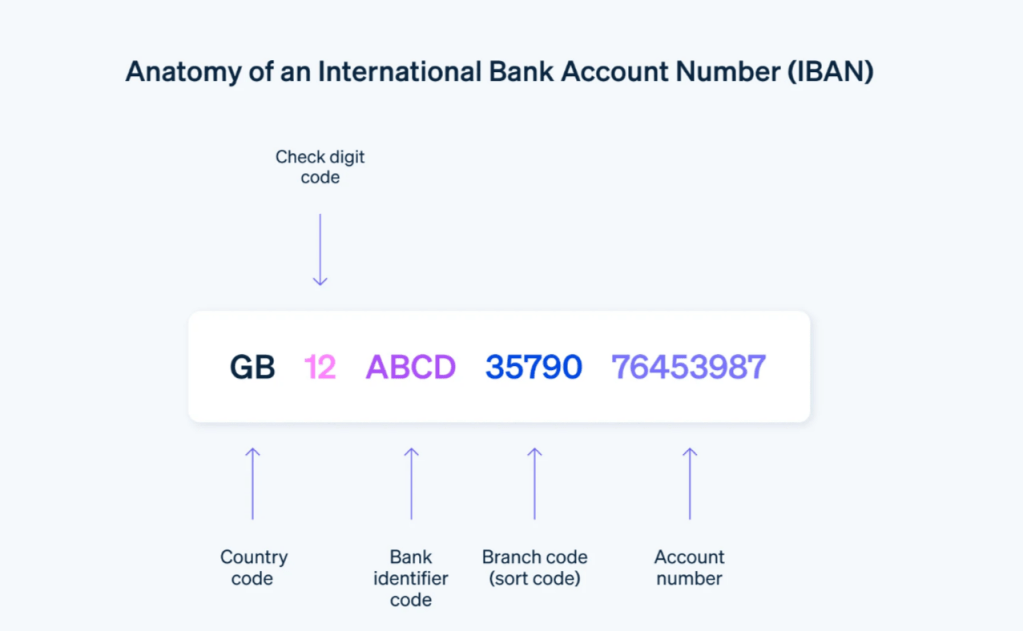
    How IBAN works: While an IBAN may appear to be random letters and numbers, each segment contains specific information for smooth payment processing:

    IBAN code components: Components of an IBAN

    1. Country Code: First two letters indicating the account’s country (e.g., GB for the United Kingdom, DE for Germany)
    2. Check Digits: The Next two numbers for validation and error detection
    3. Bank Identifier Code: Identifies the specific bank
    4. Branch Code: Identifies the specific branch of the bank
    5. Account Number: The individual account number within that branch

    IBAN Length and Format by Country

    CountryIBAN LengthStructureExample
    France27 charactersFR + 25 charactersFR14 2004 1010 0505 0001 3M02 606
    Germany22 charactersDE + 20 charactersDE89 3704 0044 0532 0130 00
    Italy27 charactersIT + 25 charactersIT60 X054 2811 1010 0000 0123 456
    Spain24 charactersES + 22 charactersES91 2100 0418 4502 0005 1332
    Netherlands18 charactersNL + 16 charactersNL91 ABNA 0417 1643 00
    Austria20 charactersAT + 18 charactersAT611904300234573201
    UK22 charactersGB + 20 charactersGB29 NWBK 6016 1331 9268 19

    IBAN example format: IBANs can have up to 34 characters maximum. Countries often format IBANs with spaces for easier reading, but both “ES9121000418450200051332” and “ES91 2100 0418 4502 0005 1332” are equally valid.

    Global IBAN Adoption

    1. Countries That Use IBAN

    The IBAN system is widely adopted in over 70 countries, concentrated in:

    • All EU Member States: Complete adoption across all European Union countries
    • EEA Non-EU Members: Including Norway and Iceland
    • Middle Eastern Countries: Saudi Arabia, UAE, Kuwait, and others
    • Caribbean Nations: Multiple Caribbean countries
    • North African Countries: Tunisia and Mauritania

    2. Major Economies That Don’t Use IBAN

    • United States: Uses ABA routing numbers and account numbers
    • Canada: Uses institution numbers, transit numbers, and account numbers
    • Australia: Uses BSB (Bank-State-Branch) codes and account numbers
    • China: Uses CNAPS codes
    • Japan: Uses Zengin codes for domestic transfers

    How to Find IBAN?

    1. Common Locations for Your IBAN

    • Bank Statements: Shown on both printed and electronic bank statements
    • Online Banking: Usually displayed on the account homepage or in:
      • Account information/details section
      • IBAN/International payments section
      • Account overview/summary page
    • Mobile Banking Apps: Found in the account details sections
    • Debit Cards: Some European cards display partial IBAN information (less common due to security concerns)
    • Contact Your Bank: Customer service can provide your IBAN via phone or email
    • Online IBAN Calculators: Third-party tools that generate IBANs from account details

    2. Security Tip

    While sharing your IBAN is generally safe for receiving payments, be cautious about who you share it with. In most countries, an IBAN alone cannot be used to withdraw funds from your account.

    IBAN Banking System: Common IBAN Problems and Solutions

    1. Issues with Incorrect IBANs

    • Transfer Rejection: IBAN Banking systems validate IBANs using check digits
    • Delayed Processing: Error correction can add days or weeks to transfer times
    • Misdirected Payments: Rare cases where funds go to the wrong accounts
    • Additional Fees: Failed transfers often result in extra charges

    2. How Check Digits Prevent Errors

    The two check digits in an IBAN use a sophisticated algorithm to catch common mistakes:

    • Transposed digits (12 written as 21)
    • Missing digits
    • Incorrect characters

    3. What to Do If You Use the Wrong IBAN

    1. Contact your bank immediately to try to stop the transaction
    2. Provide correct information for future attempts
    3. Keep all transaction documentation for tracking
    4. Be prepared for additional time to resolve issues
    5. Consider sending a small test amount before larger transfers

    IBAN Transfer Costs and Fees

    1. Standard Charges

    • Sending Bank Fee: $15-$50 fixed charge (varies by institution)
    • Intermediary Bank Fees: Charged when banks don’t have direct relationships
    • Receiving Bank Fee: Up to $30 for processing incoming transfers
    • Foreign Exchange Markup: Usually 3-5% above mid-market exchange rates

    2. Cost Reduction Strategies

    1. Use Modern Transfer Services: Wise, Revolut, and similar services often offer better rates
    2. Compare Services: Fees and exchange rates vary significantly
    3. Send Larger Amounts: Minimize the impact of flat fees by consolidating transfers
    4. Choose Optimal Currency: Sometimes better to send in the recipient’s currency
    5. Check for Fee Waivers: Premium accounts may qualify for discounts

    IBAN Security Best Practices

    A. What Someone Can Do With Your IBAN

    Possible Actions:

    • Make payments into your account.
    • Access limited information about your bank and country
    • Set up direct debits in some territories (varies by country)

    What They Cannot Do:

    • Withdraw money from your account
    • Access online banking
    • View account balance or transaction history
    • Access confidential information beyond what IBAN reveals

    B. Security Recommendations

    1. Verify Payment Details: Confirm recipient information through multiple channels.
    2. Use Secure Networks: Avoid public WiFi for banking; use VPNs when necessary.
    3. Set Up Alerts: Monitor international transactions with notifications
    4. Regular Account Reviews: Check statements periodically for unauthorized activity
    5. Avoid Phishing: Never provide banking information via email links
    6. Set Transaction Limits: Use dedicated accounts with lower limits for international transfers

    IBAN vs. Other Banking Codes

    1. IBAN vs. SWIFT/BIC Codes

    • IBAN: Identifies a specific account (like a complete address)
    • SWIFT/BIC: Identifies a specific bank (like the name of a post office)
    • Usage: Both codes are often required together for international transfers

    2. IBAN vs. US Routing Numbers

    • US System: Uses 9-digit ABA routing numbers for domestic transfers
    • International: US banks use SWIFT codes for international payments, not IBAN
    • Compatibility: US banks can still process IBAN transfers from other countries

    Processing Times for IBAN Transfers

    Transfer TypeProcessing Time
    Within the SEPA Zone1 Business Day
    Outside SEPA (Developed Markets)2-4 Business Days
    To/From Developing Markets5+ Business Days

    Factors Affecting Speed:

    • Banks involved in the transfer
    • Currencies being exchanged
    • Time of transfer initiation
    • Compliance review requirements

    Useful IBAN Tools and Resources

    Online Validators and Calculators

    • IBAN.com: Comprehensive IBAN validation and country information
    • SWIFT IBAN Registry: Official registry maintained by SWIFT
    • IBAN Calculator: Validates and generates IBANs from national account formats

    Conclusion

    Understanding IBAN is essential for anyone involved in International money transfers. Whether you’re traveling, conducting international business, or sending money to family overseas, proper IBAN knowledge ensures smoother, more cost-effective transactions.

    Key Takeaways

    • Always double-check IBAN accuracy before sending funds
    • Understand the complete cost structure of international transfers
    • Keep records of all international transactions
    • Use appropriate tools and services for your specific needs
    • Stay informed about security best practices

    As international commerce continues to grow, IBAN’s importance as a global banking standard will only increase. With this guide, you’re now equipped to navigate international banking with confidence.

    Frequently Asked Questions

    1. Is it safe to share my IBAN?

    Generally, yes, when receiving payments. Unlike credit card numbers, IBANs typically only allow credits to accounts, not debits. However, exercise caution with whom you share this information.

    1. Why doesn’t the United States use IBAN?

    The US banking system was developed separately, with routing numbers and account numbers. As the issuer of the primary reserve currency, the US has less incentive to adopt international standards, though US banks can still process IBAN transfers.

    1. Can I have multiple IBANs?

    Yes, each bank account typically has its own unique IBAN. Many people maintain multi-currency accounts with separate IBANs for different currencies.

    1. What’s the difference between domestic and international IBANs?

    There’s no difference; the same IBAN works for both domestic and international transfers within IBAN-participating countries. The IBAN structure simply contains more detailed information than traditional domestic account numbers.