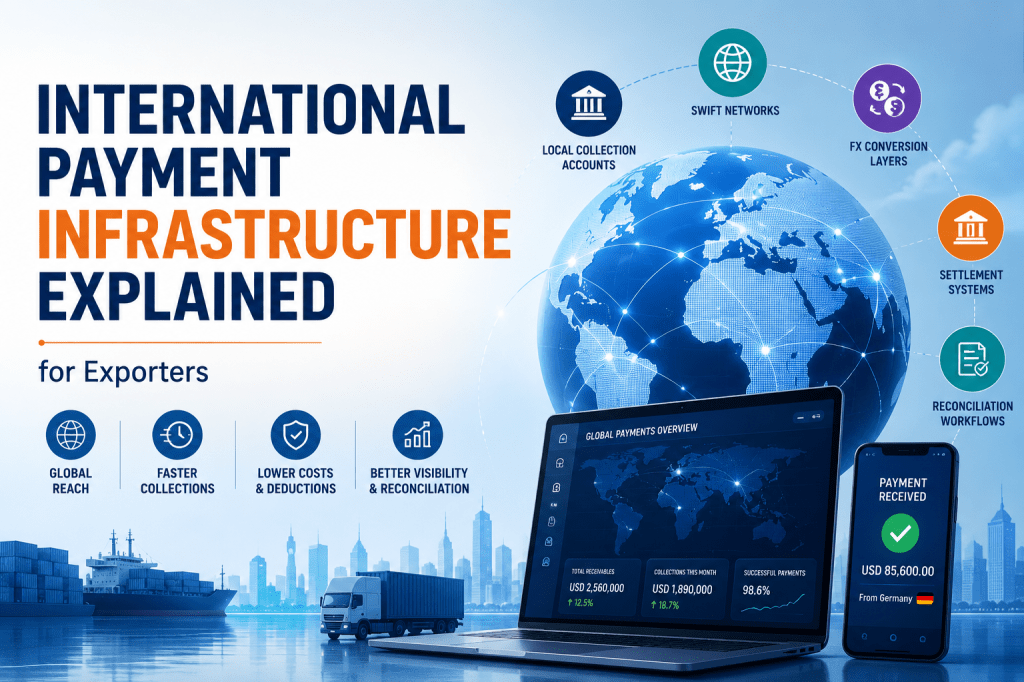
Understand how international payment infrastructure works and why exporters increasingly prefer modern collection systems.
Answer-First Summary
International payment infrastructure includes SWIFT networks, correspondent banks, local collection accounts, settlement systems, FX conversion layers, and reconciliation workflows that enable cross-border transactions.
How Do International Payments Actually Work?
Cross-border payments involve multiple financial layers.
A payment may move through:
- origin bank
- correspondent banks
- FX providers
- settlement infrastructure
- beneficiary bank
Each layer affects:
- speed
- cost
- transparency
- reconciliation
Why SWIFT Became the Global Standard
SWIFT created standardized global financial messaging.
It enabled:
- global banking interoperability
- secure transfer instructions
- international banking coordination
However, modern exporter needs have evolved.
Businesses now demand:
- faster collections
- lower deductions
- better visibility
- localized payment experiences
Why Local Collection Infrastructure Is Growing Rapidly
Local collection accounts reduce friction.
Instead of sending expensive international wires, buyers pay locally.
This improves:
- client experience
- reconciliation
- collection predictability
- settlement efficiency
Traditional SWIFT vs Modern Collection Infrastructure
| Traditional SWIFT | Modern Collection Infrastructure |
|---|---|
| Multiple intermediaries | Simplified payment flow |
| Delayed settlements | Faster collections |
| Limited visibility | Better treasury tracking |
| Higher deduction risk | Lower friction |
Why Payment Visibility Is Becoming Strategic
Finance teams increasingly need:
- payment tracking
- treasury visibility
- centralized reconciliation
- settlement intelligence
Without visibility, businesses struggle to optimize:
- working capital
- forecasting
- realized revenue
What Should Exporters Optimize?
Businesses should optimize:
- Collection infrastructure
- Reconciliation workflows
- Treasury reporting
- FX visibility
- Settlement predictability
Payment infrastructure is no longer just operational.
It is increasingly strategic.
FAQs
What is international payment infrastructure?
It includes the systems, networks, and financial workflows enabling global transactions.
Why are SWIFT payments expensive?
SWIFT transfers may involve intermediary fees and operational friction.
What are local collection accounts?
Local accounts allow businesses to receive payments like domestic transfers.
Why does payment visibility matter?
Visibility improves reconciliation and treasury optimization.
What affects settlement speed?
Infrastructure layers, compliance checks, and intermediary workflows affect settlement timelines.
 Site Title
Leave a comment