Understand how international payment infrastructure works and why exporters increasingly prefer modern collection systems.
Answer-First Summary
International payment infrastructure includes SWIFT networks, correspondent banks, local collection accounts, settlement systems, FX conversion layers, and reconciliation workflows that enable cross-border transactions.
Learn how Indian exporters can receive international payments efficiently while reducing FX losses, improving treasury visibility, and simplifying reconciliation.
Answer-First Summary
Indian exporters can receive international payments through SWIFT transfers, local collection accounts, export-focused fintech infrastructure, and AD bank networks. The best setup depends on FX transparency, reconciliation workflows, settlement speed, and treasury visibility.
Why Export Payment Infrastructure Matters More Than Ever
Many exporters still evaluate payment systems based only on transfer fees.
That approach is outdated.
Modern export businesses need to optimize:
realized revenue
FX efficiency
settlement predictability
reconciliation workflows
treasury visibility
working capital impact
The difference between invoice value and realized revenue is where many businesses silently lose money.
What Are the Main Ways to Receive Export Payments in India?
Indian exporters typically receive international payments through:
SWIFT wire transfers
Local collection accounts
Export-focused fintech platforms
Traditional AD bank infrastructure
Marketplace payout systems
Each method comes with different trade-offs.
SWIFT Transfers Explained
SWIFT is the traditional global banking messaging network used for cross-border transactions.
It works well for:
large enterprise transfers
institutional trade
regulated banking workflows
However, SWIFT payments may involve:
intermediary deductions
delayed settlements
manual reconciliation
limited visibility
What Are Local Collection Accounts?
Local collection accounts allow exporters to receive payments as if they were local businesses in another country.
Example:
A US buyer sends a domestic USD transfer.
The exporter receives settlement internationally in the backend.
This improves:
payment convenience
collection speed
reconciliation efficiency
client experience
SWIFT vs Local Collection Accounts
SWIFT Transfers
Local Collection Accounts
Multiple intermediaries
Lower friction
Higher deduction risk
Better predictability
Slower settlement
Faster collections
Manual tracking
Improved visibility
Traditional infrastructure
Modern infrastructure
Why FX Transparency Matters
Most exporters underestimate how much FX impacts profitability.
The largest hidden cost in export payments is often not transfer fees.
It is the FX spread.
An exporter receiving USD 2 million annually may lose significant revenue because of:
opaque FX pricing
delayed conversion
inconsistent treasury decisions
Modern exporters increasingly benchmark:
realized FX spread
settlement timing
effective landed INR value
How Export Payments Affect Working Capital
Delayed settlements create operational stress.
Businesses often face:
unpredictable cash flow
delayed vendor payments
treasury uncertainty
reconciliation bottlenecks
Payment infrastructure directly affects working capital predictability.
This is why finance teams increasingly treat collections as a treasury function rather than a banking workflow.
Best Practices for Exporters Receiving International Payments
Businesses should:
Benchmark FX rates against market references
Reduce intermediary-heavy payment flows
Improve payment visibility
Automate reconciliation
Optimize treasury timing
Centralize collection tracking
The goal is not only receiving payments.
The goal is maximizing realized revenue.
FAQs
What is the best way to receive export payments in India?
The best method depends on FX transparency, settlement efficiency, treasury visibility, and collection geography.
Why do exporters lose money on international payments?
Businesses often lose revenue through hidden FX spreads, SWIFT deductions, and delayed settlements.
Are local collection accounts better than SWIFT?
For recurring collections, local accounts often improve reconciliation and reduce operational friction.
What should finance teams monitor?
Finance teams should track realized FX spread, settlement timing, and collection efficiency.
How can exporters reduce FX leakage?
Businesses can reduce leakage through transparent pricing and treasury optimization.
If you have sent money abroad from India in the last few years, you have probably heard of Form 15CA and Form 15CB. These two forms have been the gatekeepers of certain outward remittances, particularly when a business or individual in India sends money to a foreign company or non-resident.
From 1 April 2026, that familiar pair is being retired. The Income Tax Act, 2025 and the Income Tax Rules, 2026 have introduced Form 145 and Form 146 as their successors. If you deal with cross-border payments to non-residents, here is what the change means for you and why it matters more than a simple rebranding.
Why the forms were renumbered in the first place
India has moved from the Income Tax Act, 1961 to the Income Tax Act, 2025. Every section number, rule reference, and form number tied to the old Act had to be rebuilt under the new framework.
Under the old law, Forms 15CA and 15CB were governed by Section 195(6) of the 1961 Act, read with Rule 37BB. Under the new law, the corresponding provision sits in Section 397(3)(d) of the 2025 Act, and the procedural rules now live in Rule 220 of the Income Tax Rules, 2026. The forms had to follow suit.
So:
Form 15CA → Form 145 (declaration by the remitter)
Form 15CB → Form 146 (certificate by a Chartered Accountant)
The purpose has not changed. Before a taxable payment leaves India to a non-resident or a foreign company, the tax department still wants the same question answered: has the correct tax been deducted at source?
Form 145: the remitter’s declaration
Form 145 is filed by the person or business making a payment to a non-resident, before the money is sent. The authorised dealer bank will not process such a remittance without it. Think of it as a customs declaration, but for money instead of goods.
Form 145 retains the four-part structure of the old Form 15CA. Which part you file depends on the nature and size of the payment:
Part A: When the remittance is taxable and the aggregate during the year does not exceed Rs. 5 lakh.
Part B: When the remittance is taxable, exceeds Rs. 5 lakh, and you already have a certificate from the Assessing Officer under Section 395(1) or 395(2) of the new Act.
Part C: When the remittance is taxable, exceeds Rs. 5 lakh, and you need a CA certificate. This is where Form 146 comes into the picture.
Part D: When the remittance is not taxable under the Act and no withholding is required.
One important update: the list of remittances exempt from Form 145 filing, previously 28 categories under Rule 37BB, has been expanded to 33 categories under Rule 220(3). Five new import-related RBI purpose codes that were earlier grey areas have now been clarified as exempt.
Form 146: the Chartered Accountant’s certificate
When a remittance to a non-resident crosses the Rs. 5 lakh threshold and is taxable in India, the tax department does not simply trust the remitter’s self-assessment of TDS. It requires an independent Chartered Accountant to examine the transaction and certify the tax position.
That is the job of Form 146. The CA:
Examines the nature of income being paid abroad
Checks whether India has a Double Taxation Avoidance Agreement (DTAA) with the recipient’s country
Applies either the treaty rate or the domestic rate, whichever is lower
Issues the certificate along with a UDIN (Unique Document Identification Number) for authenticity
Form 146 is submitted online on the income tax e-filing portal. Once uploaded by the CA, the remitter can view it in their dashboard, accept it, and then e-verify the linked Form 145 using a Digital Signature Certificate or EVC.
What stays the same
For anyone worried that every past compliance lesson is now obsolete, the good news is that the substantive requirements are unchanged:
Thresholds for triggering Form 146 are similar to what existed under the old Rule 37BB
The four-part structure of the declaration form continues
The filing is still fully online on the income tax portal
Processing time remains roughly 2 to 4 days from documentation to bank remittance
What changes in practice
The new framework brings a few genuine improvements:
Better digital integration: Form 145 and 146 are designed to be more tightly linked on the portal, reducing the duplication remitters used to face.
UDIN built in: CA certification through Form 146 now carries UDIN by default, improving traceability.
Clearer exempt list: The expanded list of 33 exempt categories removes ambiguity around common import payments.
Structured validation: The new forms include better input checks, which should reduce rejections due to formatting errors.
Transitional rules you should not miss
The shift happens on 1 April 2026, and the transition rules matter:
Forms 15CA and 15CB already filed for remittances made on or before 31 March 2026 remain valid, as long as the remittance actually takes place within the validity period mentioned in the form.
If a remittance is delayed beyond that period, fresh forms must be filed, and from 1 April 2026 onwards those fresh filings must be on Form 145 and Form 146.
For remittances with liability accruing before 1 April 2026 but paid after that date: the procedural form follows the new Act (Form 145/146), while the taxability and TDS rate continue to be governed by the 1961 Act.
This dual-law principle is worth highlighting to your CA if you have pending remittances straddling the changeover.
What this means for Fairexpay customers*
If you are sending money abroad from India to a non-resident or a foreign company, the forex partner handles execution, but the income tax compliance piece is your responsibility (or your CA’s). A few practical takeaways:
For remittances planned for April 2026 or later, ask your CA to prepare Form 145 and Form 146 rather than the old forms.
For taxable remittances above Rs. 5 lakh, engage your CA early. The 2 to 4 day window still applies, and delays on the tax side delay the transfer itself.
Keep your invoices, contracts, agreements, and bank details ready. The documentation requirements for Form 145/146 mirror the old ones.
If your remittance falls under an exempt RBI purpose code, check whether it is now in the expanded list of 33. You may avoid form filing altogether.
*Please note: Form 145 and Form 146 are not applicable to individuals remitting money abroad with Fairexpay under the Liberalised Remittance Scheme (LRS), such as for overseas education, travel, gifts, maintenance of close relatives, or investments under the USD 250,000 annual limit. These forms apply only when a business or individual in India makes a taxable payment to a non-resident or a foreign company.
The bottom line
The move from Form 15CA/15CB to Form 145/146 is not a disruption, it is a modernisation. Same obligation, new architecture, slightly better user experience. The senders who will feel the change least are those who stay informed, work with their CA ahead of time, and choose a remittance partner that understands both the forex and the tax side of cross-border payments.
At Fairexpay, we make sure the forex execution is seamless and transparent. Whether you are an individual sending money under LRS or a business making a payment to a foreign vendor, we help you transfer abroad with confidence.
Need help planning your next international transfer? Visit Fairexpay.com to compare live rates and book your remittance with confidence.
The Union Ministry of Finance has revised TCS rates on foreign remittances under the Liberalised Remittance Scheme. Here is everything you need to know, and how Fairexpay helps you save.
What Is TCS on LRS?
Tax Collection at Source (TCS) has been applicable since 1st October 2020 on all transactions under the Liberalised Remittance Scheme (LRS). Under LRS, resident individuals in India can remit up to USD 2,50,000 per financial year for purposes like education, medical treatment, travel, gifts, and investments abroad.
TCS is collected by the authorised dealer (bank or FFMC) at the time of remittance and can be claimed as a credit when filing your Income Tax Return. It is not an additional tax; rather, it is an advance collection that gets adjusted against your total tax liability.
Key point: TCS applies on the total foreign remittance amount exceeding INR 10,00,000 in a financial year. This threshold is calculated by aggregating all LRS remittances, including education loan disbursements, made through any AD I bank, AD II, or FFMC.
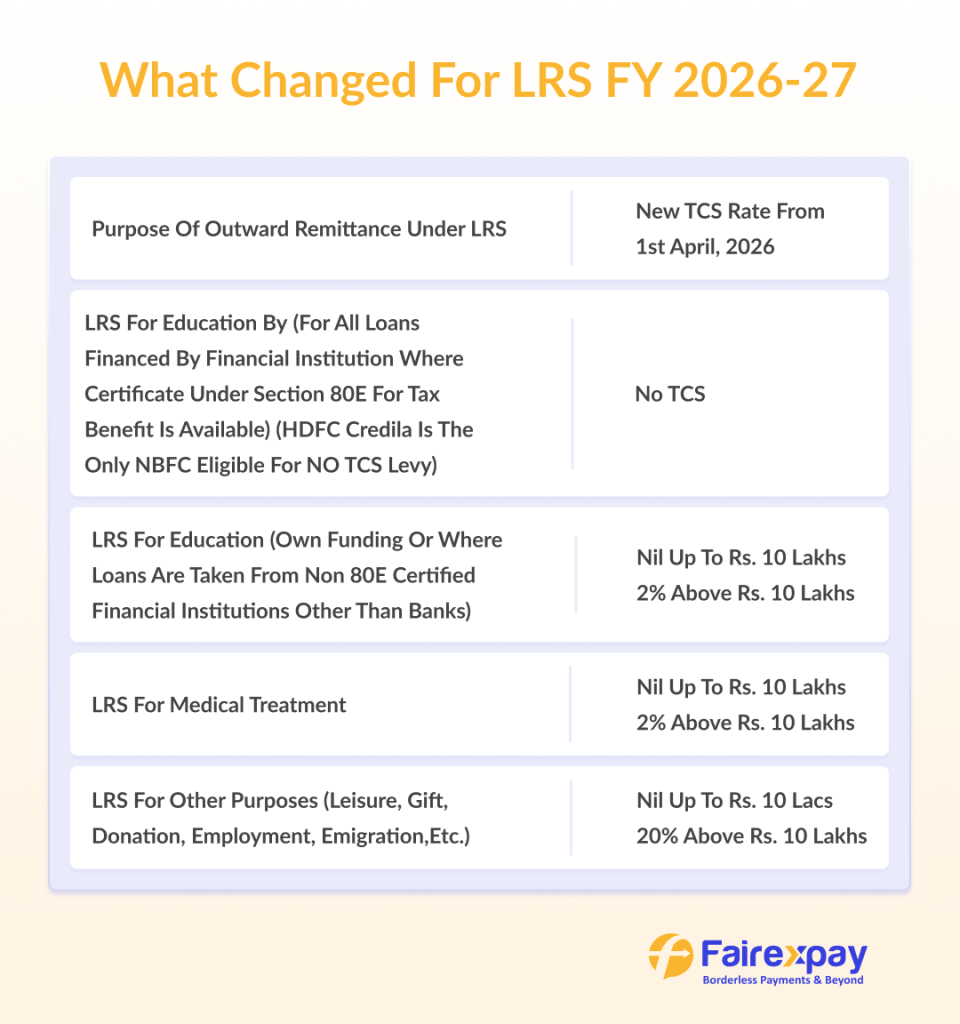
Revised TCS Rate Table (Effective 1st April 2026)
The Union Ministry of Finance has amended the TCS rules. Below are the revised rates applicable from FY 2026-27 onwards.
Purpose of Outward Remittance
New TCS Rate (from 1 April 2026)
Education (loan financed by a financial institution with Section 80E certificate). HDFC Credila is the only NBFC eligible for no TCS levy.
NO TCS
Education (own funding, or loans from non-80E certified financial institutions other than banks)
Nil up to Rs. 10 Lakhs / 2% above Rs. 10 Lakhs
Medical Treatment
Nil up to Rs. 10 Lakhs / 2% above Rs. 10 Lakhs
Other Purposes (leisure, gift, donation, employment, emigration, etc.)
Nil up to Rs. 10 Lakhs / 20% above Rs. 10 Lakhs
Important: TCS is calculated on the total remittance amount inclusive of all charges and taxes, including GST. So your effective remittance cost factors in processing fees, GST, and TCS combined.
Breaking Down the Changes
Good News for Students with Education Loans
If you are funding your education abroad through a loan from a financial institution that provides a Section 80E certificate, you owe zero TCS regardless of the amount. This is a significant relief for families managing large tuition fee payments. HDFC Credila remains the only NBFC where this benefit applies.
Self-Funded Students and Medical Remittances
For students funding their own education or those taking loans from non-80E certified institutions, the TCS rate has been reduced from 5% to 2% on amounts exceeding Rs. 10 Lakhs. This is a meaningful drop that puts more money back in your hands. The same reduced rate of 2% applies for medical treatment remittances as well. Remittances up to Rs. 10 Lakhs in a financial year continue to attract nil TCS.
Leisure, Gifts, and Other Purposes
Remittances for travel, gifts, donations, employment transfers, and emigration continue to attract a 20% TCS on amounts above Rs. 10 Lakhs. While this rate remains unchanged from the previous structure, it is worth noting that this is the highest TCS slab across all LRS categories. The amount is refundable as a tax credit, but it does lock up a substantial sum until you file your ITR. If you are planning large remittances under this category, factor in the cash flow impact and time your transfers accordingly.
How the INR 10 Lakh Threshold Works
The Rs. 10 Lakh threshold is not per transaction or per purpose. It is an aggregate annual limit across all your LRS remittances in a financial year, irrespective of the bank or FFMC you use. Once your cumulative LRS remittances cross Rs. 10 Lakhs, TCS kicks in on the excess amount at the applicable rate based on the purpose.
How Fairexpay Helps You Save More
TCS aside, the real cost of sending money abroad lies in exchange rate markups and hidden fees. This is exactly where Fairexpay makes a difference.
Mid-Market Rates Fairexpay offers rates close to the mid-market rate with transparent, low markups. No hidden charges buried in unfavourable exchange rates.
Transparent Fee Structure Processing fees start from just 0.4%. You see exactly what you are paying before confirming your transfer.
T+1 Processing Your money reaches its destination fast, with next-day processing to 180+ countries across 15+ currencies.
Built for Education Direct tuition fee payments, living expense transfers, GIC payments, and exam fee remittances, all from one platform.
When you are already paying 2% or 20% in TCS on top of your remittance, the last thing you want is to lose more money to inflated exchange rates. Fairexpay can save you thousands of rupees on every transfer compared to what a traditional bank charges.
Quick Tips to Manage Your TCS Liability
Plan your remittances early. Spread transfers across the financial year to manage cash flow, especially if the total will exceed Rs. 10 Lakhs.
Use education loans with 80E certification. If you are sending money for education, a loan from an 80E-certified institution means zero TCS.
Claim TCS credit on your ITR. TCS is not a sunk cost. File your return on time and claim the credit against your total tax liability.
Minimise other costs. Use Fairexpay for competitive exchange rates and low fees so that TCS is the only additional charge you bear.
Keep records. Maintain documentation of all remittances, loan certificates, and TCS challans for a smooth ITR filing process.
Note for Tour Operators
In the case of remittances made by tour operators, TCS is required to be collected by the tour operator themselves. The authorised dealer requires a TCS declaration from the tour operator as per the format prescribed by the Authorized Dealer.
Ready to Send Money Abroad?
Save more on every international transfer with Fairexpay. Transparent rates, fast processing, and zero hidden fees.
The revised TCS rates from 1st April 2026 bring important changes for anyone remitting money abroad under LRS. The Rs. 10 Lakh nil-TCS threshold is a welcome relief for smaller remittances, but the 20% rate on non-essential purposes above that limit means careful planning is essential.
Whether you are a parent paying tuition fees, a professional transferring funds for employment, or someone sending gifts to family overseas, understanding these rates helps you budget better and avoid surprises. And when it comes to the actual cost of the transfer, Fairexpay is designed to give you the best value with transparent pricing and competitive rates.







 Site Title